What Is Streetwear?

Quick answer
July 1986, Madison Square Garden: Run-DMC play “My Adidas”, and thousands of fans hold their adidas in the air. That is streetwear in a nutshell: clothing a scene claimed for itself and turned into its uniform, long before any fashion house noticed. It means graphic tees, hoodies, baggy trousers and sneakers from the worlds of surfing, skating and hip-hop, mostly made in small runs and sold on fixed dates.
Streetwear at a glance
- Origin: surfing, skating, hip-hop and graffiti
- First brand: Stüssy, early 80s in Laguna Beach
- Graphics: a print, logo or lettering shows where you belong
- Cut: comfortable and mostly loose
- Sales: small runs, drops on fixed dates
- Core wardrobe: graphic tee, hoodie, baggy trousers, sneakers, cap
- Germany: adidas and Puma from Herzogenaurach, Carhartt WIP from Weil am Rhein
- Today: Louis Vuitton and other luxury houses have taken the style on
Quick questions
What is streetwear, simply explained?
Everyday clothing from the skate, surf and hip-hop scenes: graphic tees, hoodies, baggy trousers, sneakers. Add strong prints and small runs that come out as a drop.
Who invented streetwear?
No single person did. Stüssy is usually named as the first streetwear brand: in the early 80s in California, Shawn Stussy turned his surfboard signature into a label, while in New York the look of hip-hop took shape at the same time.
Which brands are streetwear?
The classics are Stüssy, Supreme, A Bathing Ape, Carhartt WIP and Palace, and for shoes Nike, adidas and Vans. Then there are plenty of small labels, some of them from Germany, that sell in drops.
Is streetwear for women too?
Yes, it always has been. Most streetwear shirts are cut unisex, at HUSTLE&PAIN all of them, and a good way in is a boxy shirt with high-waisted trousers.
Is streetwear still a subculture?
On the surface it is mainstream, at the latest since Virgil Abloh and Pharrell Williams took over menswear at Louis Vuitton. Underneath, the scene lives on, in skate parks, at gigs and at small brands that design their own shirts.
In detail: from Laguna Beach to Paris
That evening, Angelo Anastasio of adidas was in the audience at the invitation of Run-DMC's manager Lyor Cohen. Soon afterwards, Run-DMC had an endorsement deal that is considered the first between musicians and a sportswear brand. Ever since, the fashion industry has been chasing the street. Usually a few years late.
Streetwear explained: how to recognise it
A grey shirt from a discount store is casual wear. The same shirt with the logo of a Manhattan skate shop is streetwear, and suddenly people queue for it. Same fabric. What changed is the meaning.
Four traits show up almost every time:
- Roots in a scene: surfing, skating, hip-hop, graffiti, later basketball and techno.
- The graphic talks. A print, logo or lettering shows where you belong.
- Comfortable, mostly loose cuts, made for moving.
- Limited numbers. Many brands keep stock scarce on purpose, because whatever everybody wears loses its charm.
Where does streetwear come from? From California via New York to Tokyo
California: empty pools and a signature
In 1976 and 1977, Southern California is in drought. To save water, people leave their swimming pools empty, and the Z-Boys from Venice and Santa Monica skate the concrete bowls. Vans, founded in Anaheim in 1966, brings out the Era in 1976, for which the skaters Tony Alva and Stacy Peralta contributed a padded collar.
In the early 80s, Shawn Stussy shapes surfboards in Laguna Beach and signs each one with a scrawled signature, written with a fat marker. He prints the signature on T-shirts to make his boards better known. At his first trade shows, everyone who buys a board asks about the shirts too, which were never really for sale. In 1984 he teams up with a friend, Frank Sinatra Jr., no relation to the singer, to sell the clothing. Soon there are friends of the brand in London, Tokyo and New York who call themselves the International Stüssy Tribe, among them Hiroshi Fujiwara and James Jebbia, later the founder of Supreme. A logo as a membership card. Streetwear still works on that principle today.
New York and L.A.: hip-hop turns sports brands into a uniform
In August 1973, DJ Kool Herc spins at a party in the Bronx, in the community room of his apartment block on Sedgwick Avenue, and hip-hop grows out of it. The clothes come from the sports shop and the building site: tracksuits, Puma and Pro-Keds sneakers, Timberland boots, Carhartt. LL Cool J makes the Kangol bucket hat his trademark, Run-DMC wear their adidas without laces. In 1985 comes the Air Jordan 1, built for the hardwood, worn on the asphalt.
From 1982, in Harlem, Dapper Dan tailors jackets with the logos of Gucci, Louis Vuitton and Fendi, for rappers and boxers such as Mike Tyson, without any licence. After raids and lawsuits, the last one from Fendi, his shop closes in 1992. In 2017, Gucci shows a jacket that looks strikingly like one of his designs. After the outcry, the house works with him officially.
On the West Coast the look is different. In the late 80s, N.W.A wear Raiders caps and Dickies work trousers in Compton, the counterpoint to the Timberlands and hoodies of New York.
In 1994, James Jebbia opens a skate shop called Supreme on Lafayette Street in Manhattan. The logo, white Futura on a red bar, goes back to the work of the artist Barbara Kruger. Probably the most famous red rectangle in fashion.
Tokyo: scarcity becomes a system
In the early 90s, tiny shops open in the side streets of Harajuku, and the scene calls the district Ura-Harajuku. Hiroshi Fujiwara, a DJ and himself part of the Stüssy tribe, is considered its godfather. In 1993, Nigo founds A Bathing Ape there and does something that sounds mad at the time: he deliberately produces less than he could sell, around ten per cent of demand. Anyone who wants a piece with the ape camo queues or goes home empty-handed.
Paris: the catwalk gives way
In 2000, Louis Vuitton demands in a cease-and-desist letter that Supreme take skateboards with a pattern very similar to the LV monogram off the market. In January 2017, the Louis Vuitton menswear show in Paris sends bags and jackets down the catwalk that carry both logos. A year later, Virgil Abloh, founder of Off-White, becomes artistic director of menswear at Louis Vuitton, the first designer of African descent in that post. In 2023, Pharrell Williams takes over.
The rest is in the balance sheets. In 2020, the group VF, which also owns The North Face and Vans, buys Supreme for $2.1 billion; in 2024 the brand goes to EssilorLuxottica, the group behind Ray-Ban, for $1.5 billion. Whether that betrayed the scene has been argued about in every forum since. Our view: the best pieces always came from people who belong to it themselves. A Louis Vuitton bag with the box logo is a collector's item. Nobody skates with it.
Streetwear in Germany: Franconia, Münster, Weil am Rhein
A detail that tends to get lost: the brand from “My Adidas” is based in Franconia (northern Bavaria). adidas and Puma both have their headquarters in Herzogenaurach, founded by the feuding brothers Adi and Rudolf Dassler.
The big push for hip-hop in the 80s came from the cinema: Wild Style and above all Beat Street from 1984, which was so popular even in East Germany that countless breakdance, hip-hop and graffiti crews formed in its wake. After that, people breakdanced and sprayed in pedestrian zones and youth centres, in tracksuits, of course. Skating was already there: Titus Dittmann started a skateboard business in Münster in 1978, officially in his wife's name, because as a teacher he was not allowed to register a business. He flew to California regularly to get hold of boards and brought the culture over, clothes included. In 1991, Tresor, the city's first techno club, opened in Berlin, and in the club people wore what also worked on the street.
Carhartt was founded in Detroit in 1889 to clothe workers. Exactly a hundred years later, Edwin Faeh from Switzerland began bringing the workwear to Europe. In 1994 that became Carhartt WIP, at first as sole distributor for Europe, from 1997 with its own designs for the scene, based in Weil am Rhein on the Swiss border.
Today Germany has a whole string of small labels with their own prints, their own community and drops instead of seasonal stock, some of them listed in Streetwear Brands from Germany. HUSTLE&PAIN is one of them.
Streetwear, street style, urban wear: what is the difference?
- Streetwear: brands and clothing that come from skating, surfing and hip-hop, with graphics, logos and small runs.
- Street style: everything people wear on the street, whatever the style. The best-known example comes from photography: Bill Cunningham photographed passers-by in Manhattan for the New York Times from 1978 to 2016.
- Urban wear: a term from retail, mostly for fashion that came out of hip-hop, such as baggy jeans and tracksuits. Today almost the same as streetwear.
- Sportswear: clothing for sport. It becomes streetwear as soon as it leaves the playing field, like the adidas Superstar, which started out in 1969 as a basketball shoe.
Typical streetwear clothing: the core wardrobe
- Graphic tee: the heart of every look. A good shirt for loose cuts weighs around 300 GSM, almost stands up on its own and hangs straight instead of clinging to the body. You will find a selection in the Graphic Tees.
- Hoodie and zip hoodie: heavy fleece, a hood that holds its shape, cuffs that do not stretch out after washing.
- Trousers: baggy jeans, cargos, Dickies work trousers, joggers with cuffs.
- Sneakers: Air Jordan 1 and Nike Dunk from 1985, adidas Superstar from 1969, Vans Old Skool from 1977. Nearly all the classics are older than most of the people who wear them.
- Headwear: cap, beanie, bucket hat.
- Jacket: workwear jacket, varsity jacket, puffer.
Streetwear brands that shaped the style
- Stüssy (Laguna Beach, early 80s): the signature that started it all.
- Supreme (New York, 1994): red box logo, Thursday drops, queues outside the shop.
- A Bathing Ape (Tokyo, 1993): ape camo and deliberately too little stock.
- Carhartt WIP (Weil am Rhein, since 1994): workwear, translated for skaters and graffiti writers.
- Palace (London, 2009): the skate brand of Lev Tanju, with its triangle logo and British humour.
- Off-White (Milan, 2013): Virgil Abloh's label with quotation marks and diagonal stripes, the bridge to the catwalk.
- Fear of God (2011): Jerry Lorenzo, muted colours, big silhouettes.
- Kith (New York, 2011): Ronnie Fieg turns the sneaker shop into a meeting place.
On logo hype: on the resale market, a box-logo hoodie can cost several times the shop price. The extra you pay is for the logo and the scarcity, not for the fabric.
How do drops work?
A drop is a sales date. Date and time are fixed in advance, the quantity is small, and what is gone is gone. Supreme made the ritual famous: new pieces arrive in small groups every Thursday, and outside the store in London queues ran round the block almost every day. For sought-after sneakers, brands raffle off the right to buy, Nike for example in the SNKRS app.
Sounds like a marketing trick, but there is a practical reason. If you produce in small quantities, you do not get stuck with stock, and every piece stays something not everyone has.
The vocabulary around drops, in short:
- Restock: a sold-out piece comes back.
- Resell: selling on, usually above the shop price, for example via StockX.
- Grail: the one piece you have been after for years.
- Collab: two brands, one product, like Louis Vuitton and Supreme.
- Deadstock: unworn, with tags, ideally in the original box.
Here is how it works with us: every collection comes out in small quantities, H|W 26 “Rockstar Attitude” above all. Some designs exist only once. Others we bring back if enough people ask for them. If your size is gone, you sign up on the product page and get an email as soon as it is back.
Streetwear outfit: how to build the look
With streetwear style, the silhouette makes the biggest difference, often more than the shirt itself.
Start with the shirt
The shirt is the loudest piece, so it comes first. A big print with quiet trousers puts the focus on the shirt. If the shirt is plain, the jacket can do the talking.
Pick a silhouette
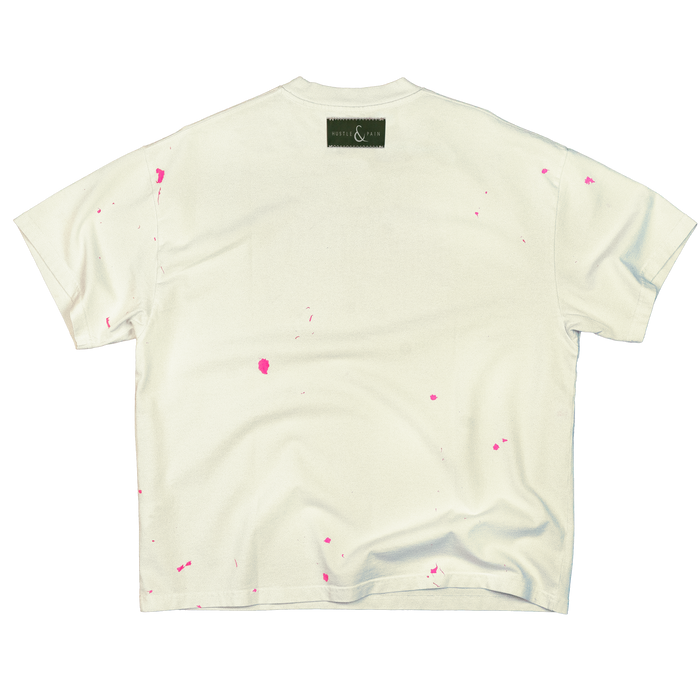
- Wide and wide: oversized shirt, baggy jeans or cargos, a shoe with volume. The skate look of the 90s. ANTAGONIST in Vintage White with pink lettering sits like that with light, baggy jeans. The other wide shirts are under Oversized T-Shirts.
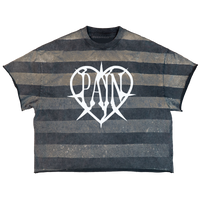
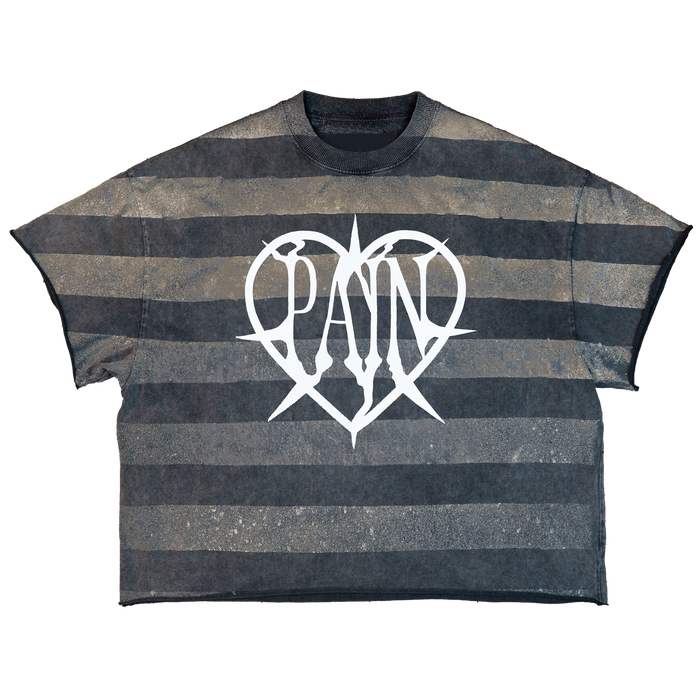
- Short and high: a boxy shirt is wide and slightly shorter, with high-waisted trousers underneath. That makes the legs look longer. FUGITIVE with bleached stripes is cut for exactly this.
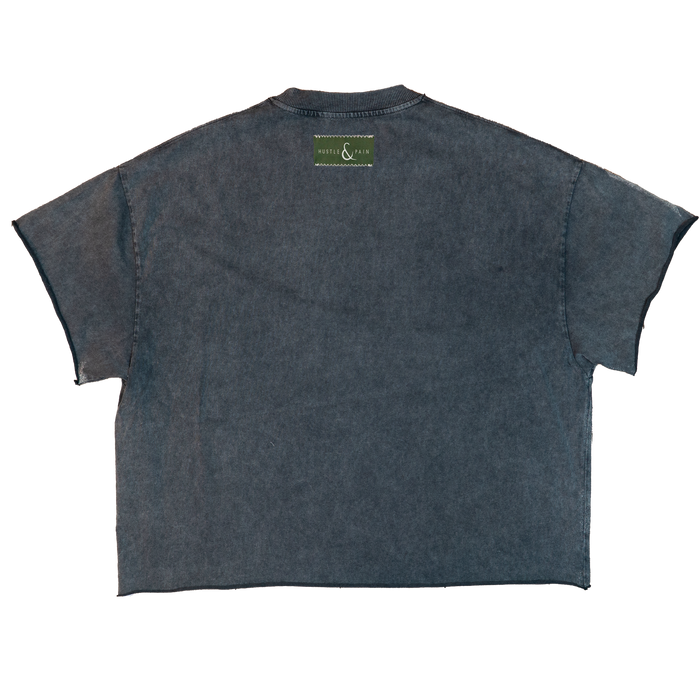
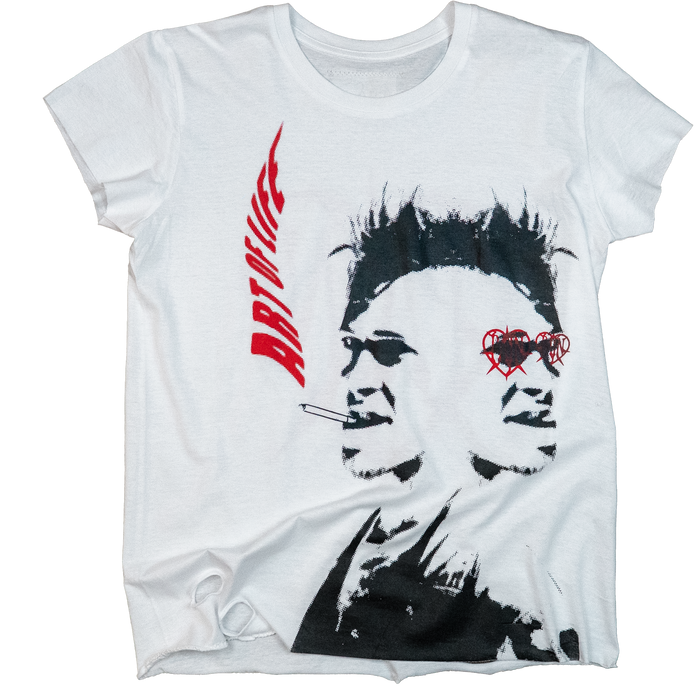
- Tight on top, loose below: slim fit with baggy jeans, the look of the early 2000s, more in Y2K Style. ART OF LIFE with the red PAIN heart on the back hits that era almost exactly.
How the three cuts fall in detail is covered in the comparison Boxy vs. Oversized vs. Slim Fit.
One loud colour or more
Black, grey, white and denim are the base. One loud colour sets an accent, such as the pink on ANTAGONIST or the yellow exclamation mark on ENERGY. A big print, two signal colours and colourful sneakers all at once make the look very loud. If you want it calmer, take one of them out.
Layering for autumn and winter
A long-sleeve under the T-shirt is the simplest layer. Over it, an open shirt or a workwear jacket. For layering, a long cut pays off: YOKO ONO is cut extra long and without a shoulder seam and peeks out a little from under any jacket.
Streetwear for women and men: the same shirts
Streetwear was never a men-only business. In the 90s, TLC and Aaliyah wore baggy trousers with crop tops and huge shirts, and Aaliyah posed for Tommy Hilfiger. All our shirts are unisex, and styling makes the difference. On narrow shoulders an oversized shirt sits even looser, the seam slides towards the elbow, and that is exactly how it is meant to look. If you like it close to the body, take DIRT MOUTH, a slim fit with short, narrow sleeves, and wear it with baggy jeans or a long skirt.
How do you spot good streetwear?
The logo tells you little about quality. These four points tell you more:
- Weight: loose cuts need fabric with substance, 250 to 300 GSM. Slim fits can be lighter because they sit close to the body. What the number means is explained in the GSM guide.
- Print: a screen print has rich colour and sharp edges, even after many washes.
- Collar: after the first wash it lies flat and does not curl.
- Wash: if it is done by hand, every piece looks a little different. That is intentional.
Sources40
- Wikipedia: My Adidas (English)
- Wikipedia: Streetwear (English)
- Wikipedia: Z-Boys (English)
- Wikipedia: Vans (English)
- Thrasher Magazine: Wax the Coping, Classic Skate Vans (English)
- Wikipedia: Stüssy (English)
- Highsnobiety: Shawn Stussy Biography (22 Jan 2016, English)
- i-D: Stüssy's London Tribe and the Dover Street Market collaboration (English)
- Wikipedia: DJ Kool Herc (English)
- Wikipedia: Hip-hop fashion (English)
- Wikipedia: Kangol (English)
- Wikipedia: Run-DMC (English)
- Wikipedia: Air Jordan (English)
- Wikipedia: Dapper Dan (English)
- Wikipedia: Supreme (English)
- Wikipedia: Hiroshi Fujiwara (English)
- Wikipedia: A Bathing Ape (English)
- Highsnobiety: Fashion History Lessons, NIGO (23 Dec 2020, English)
- The Fashion Law: Two of Fashion's Favorite Lawsuits Never Actually Happened (22 Aug 2019, English)
- Wikipedia: Virgil Abloh (English)
- Wikipedia: Louis Vuitton (English)
- Wikipedia: VF Corporation (English)
- Wikipedia: Adidas (German)
- Wikipedia: Beat Street (German)
- Wikipedia: Titus Dittmann (German)
- Wikipedia: Tresor (Club) (German)
- Wikipedia: Carhartt (German)
- Carhartt WIP: About, company history (English)
- Berufsstart.de: Firmengeschichte von Carhartt WIP (German, with company address)
- Wikipedia: Bill Cunningham (English)
- Wikipedia: Adidas Superstar (English)
- Wikipedia: Nike Dunk (English)
- Wikipedia: Palace Skateboards (English)
- Wikipedia: Off-White (English)
- Wikipedia: Jerry Lorenzo (English)
- Wikipedia: Kith (English)
- Highsnobiety: BAPE, Everything You Ever Wanted to Know (27 Sep 2023, English)
- Inverse: Nike's changing how SNKRS app works (3 Mar 2022, English)
- Wikipedia: StockX (English)
- Wikipedia: Aaliyah (English)
From the article


Keep reading
-
 Style11 minWhat Is Gothic Streetwear?
-
 Style13 minWhat Goes with a Black T-Shirt?
-
 Style13 minWhat Goes with a Grey T-Shirt?