What Does GSM Mean on T-Shirts?

Quick answer
GSM stands for grams per square metre, the weight of one square metre of the fabric the shirt is cut from. The higher the number, the more cotton is packed into the same area, and the thicker and heavier the T-shirt. It says less about quality than many people think, because yarn and knit count just as much.
What GSM counts as a thick T-shirt?
There is no fixed line. From around 220 GSM you can clearly feel a firmer fabric, and in streetwear, shirts of 250 to 300 GSM count as properly heavy.
Is a higher GSM T-shirt better?
Not automatically. GSM describes weight and feel. How long a shirt keeps looking good depends just as much on the yarn and how it is made.
Is a 300 GSM T-shirt too warm for summer?
Not on a normal summer’s day, but above 30 °C you will notice the fabric. In a heatwave, light shirts up to around 160 GSM are more comfortable.
How do you convert oz to GSM?
Ounces per square yard times 33.9 gives grams per square metre. So 6 oz is roughly 203 GSM, and 300 GSM is roughly 8.8 oz.
GSM at a glance
- GSM: grams per square metre, measured on the fabric, not on the whole shirt
- Measuring: weigh a round sample of 100 cm², multiply the result by 100
- Converting: oz/yd² times 33.9 gives GSM
- Lightweight: up to around 160 GSM, thin and airy
- Midweight: around 160 to 220 GSM, the standard everyday T-shirt
- Heavyweight: from around 220 GSM, fabric with a shape of its own
- More GSM: more opaque, stands further away from the body, warmer
- Just as important: yarn and knit
- Our shirts: 150, 180, 250 and 300 GSM
In detail: measuring, converting, feeling the difference
A sheet of office printer paper weighs 80 grams per square metre. From 250 grams, the paper trade calls it card. Our heaviest T-shirts sit at 300.
The number now appears on plenty of streetwear product pages, right next to the price. It tells you a lot about how a shirt hangs and whether it is see-through. It tells you less about quality: a 300 GSM shirt made from cheap yarn can look more tired after one summer than a well-spun shirt at 180.
What does GSM mean? Grams per square metre of fabric
GSM is the weight of a fabric per unit of area. In German it is also called Grammatur, the same word as for paper (grammage in English), and it applies to paper, film and textiles alike. A shirt with 300 GSM is cut from a fabric of which one square metre weighs 300 grams. At 150 GSM, the same area holds half as much cotton.
The number belongs to the fabric, not to the garment. A shirt in XXL weighs more than the same model in S, but the GSM is the same for both. And GSM measures weight, not thickness. Most of the time the two go together, but a loosely knitted, fluffy fabric can seem thicker than a smooth, densely knitted one with more grams.
How is GSM measured? With a circle cutter and a precision scale
Nobody cuts out a whole square metre for this. At the knitting mill or in the testing lab, a circle cutter punches a round sample out of the fabric, exactly 100 square centimetres, just under 11.3 centimetres across. The disc goes on a precision scale, and the result times 100 is the GSM. If the sample weighs 3.0 grams, the fabric is 300 GSM. In Germany, how fabric weight is determined from small samples like these is set out in the standard DIN EN 12127.
Before weighing, the samples are left in a fixed indoor climate, the standard atmosphere set by DIN EN ISO 139, because cotton draws moisture from the air: once conditioned, it contains around 8.5 per cent moisture. The same disc therefore weighs more after a night in a damp cellar than after one in a heated office. A few per cent either way is normal, and for some of its shirts Printful notes that the weight can vary by 5 per cent. Nobody will ever feel the difference between 290 and 300 GSM.
One detail is almost never mentioned. As a rule, the number describes the fabric before it was cut. If the finished shirt shrinks later, the same amount of cotton sits on a smaller area, and the GSM goes up. A shirt that has shrunk in the tumble dryer has a higher GSM afterwards. It is no better for it.
Converting GSM to oz: 1 oz/yd² is roughly 33.9 g/m²
American makers such as Gildan, Hanes or Comfort Colors give fabric weight in ounces per square yard, oz/yd² for short, or simply oz. An ounce is 28.35 grams, a square yard is 0.836 square metres. That makes 1 oz/yd² roughly 33.9 g/m². Ounces times 33.9 gives GSM, GSM divided by 33.9 gives ounces.
- 150 GSM: roughly 4.4 oz
- 180 GSM: roughly 5.3 oz
- 200 GSM: roughly 5.9 oz
- 250 GSM: roughly 7.4 oz
- 300 GSM: roughly 8.8 oz
One more trap: some shops put “30 singles” or “Ne 30” in the description. That figure has nothing to do with weight. It gives the fineness of the yarn, and it runs the other way round. The higher it is, the finer the yarn, so 30 singles are finer than 18 singles.
Lightweight, midweight, heavyweight: what GSM is normal?
There is no binding line for how many grams a T-shirt needs before it counts as heavy. Printful talks about heavy T-shirts from 180 to 200 GSM, while SANVT recommends more than 200 for heavyweight. From a streetwear point of view, this breakdown works:
- Lightweight, up to around 160 GSM: thin and airy, sits close to the body. A white shirt in this class is rarely fully opaque.
- Midweight, around 160 to 220 GSM: the standard everyday T-shirt. Gildan calls its classic 5000 “Heavy Cotton” and lists it at 5.3 oz, so roughly 180 g/m². According to Printful, the Comfort Colors 1717 comes in at 6.1 oz, roughly 207 g/m².
- Heavyweight, from around 220 GSM: firm fabric with a shape of its own. Represent lists 230 GSM for its Initial Boxy T-Shirt, ours are 250 and 300.
- Over 300 GSM: this is where the T-shirt starts edging towards a sweatshirt.
What a US wholesaler like Gildan calls heavy is mid-range in streetwear. Read the number every time, never just the name.
What changes with more GSM?
Drape and silhouette: does the fabric stand or flow?
Light jersey follows the body. It settles over the shoulders, flaps about when you cycle and clings to your back in July. Heavy jersey keeps its distance. At 300 GSM the fabric stands away from the chest, the shoulder keeps its edge, and the hem falls straight down instead of wrapping itself round the hips.
That is why oversized and boxy cuts depend on weight. A wide cut in 150 GSM jersey soon looks like a nightshirt bought two sizes too big. The same cut in 300 GSM looks deliberate.
See-through or not: the white T-shirt problem
Under changing-room lights, a white shirt at 140 or 150 GSM is happy to show what is underneath: chest hair and the edge of your vest. The heavier the fabric, the less shows through, and at 300 GSM white simply stays white. With black it hardly matters, though thin fabric there tends to show every crease over the stomach.
Durability and shrinking
More fibres per square metre means more material to wear through before a hole appears, and a fabric that does not go baggy as quickly. Weight does not protect against shrinking, though. Cotton contracts in hot water and in the tumble dryer, however thickly it is knitted. So for every one of our shirts:
- turn it inside out, because otherwise the print rubs against the drum
- wash at 30 °C, because cotton shrinks more in hot water
- no tumble dryer, because nowhere does cotton shrink as much as in there
Season and price
On hot days light shirts are more comfortable, because thin fabric lets more air through and dries faster. SANVT recommends 160 GSM or less for summer. A 300 GSM shirt is for spring and autumn, and for the layer under a jacket or overshirt. On a packed underground train in August, you feel every gram.
On price, the maths is simple. A fabric at 300 GSM needs twice as much cotton per square metre as one at 150, and the parcel weighs more too. So a heavy shirt almost always costs more. If one is suspiciously cheap, take a closer look at the yarn.
Why GSM isn’t everything: yarn, knit, loopwheel
There are two ways to get to 300 grams per square metre. You can knit a thick yarn loosely or a fine yarn very densely. On the scale they come out the same, in your hand they do not: the loose knit often feels rougher and is more likely to twist out of shape, while the dense one stays smooth and holds its form.
Combed, ring-spun, open-end: the yarn makes the feel
- Open-end yarn, also called rotor yarn, is spun faster and with less work than ring-spun yarn. Its fibres lie less parallel, and the fabric feels fluffier and wears out sooner.
- Ring-spun yarn is made more slowly, and its fibres lie more parallel. It feels smoother and lasts longer.
- Combed cotton is combed through before spinning, which gets rid of the short fibres and lines up the long ones. The yarn turns out smoother and stronger, and a screen print sits on a calmer surface.
Single jersey, interlock, loopwheel: the knit
Almost every T-shirt is made of single jersey: one smooth side on the outside, a rougher one on the inside. Interlock is double-knitted, smooth on both sides and heavier, stretches less and holds its shape better.
Loopwheel is fabric made on slow-running circular knitting machines. Today it is best known from Wakayama in Japan, where, according to the brand Loopwheeler, around 200 of these old circular knitting machines are still running. They turn slowly, at 24 revolutions per minute, and barely pull on the yarn, so it stays relaxed. The fabric comes out as a tube, which gives you a shirt with no side seams. In Germany, the brand Merz b. Schwanen has got a loopwheel factory from the 1920s running again.
What happens after sewing changes the feel as well. A shirt that is washed or bleached afterwards loses the stiffness it had on the bolt. Many of our shirts are washed or bleached afterwards, which is why a 300 GSM shirt from us often does not feel fresh out of the box. For more on how to judge yarn and make, see How to Tell If a T-Shirt Is High Quality?
What do you call T-shirts made of thick fabric?
Most often a heavyweight T-shirt, heavy tee for short, or simply a thick T-shirt. US wholesale adds model names like “Heavy Cotton” from Gildan or “Beefy-T” from Hanes, listed there at 6.1 oz, so roughly 207 g/m². For the class in between, midweight has become the usual word.
A name is not a number. A shop that really works with heavy fabric puts the number on the page.
Thick T-shirts for men and women: it comes down to the cut
Fabric weight has no gender. The cut, more or less, does. Heavy fabric gives less than thin jersey. A close fit feels tighter in it, and at the waist and under the arms the fabric stands away where a thin one would simply lie flat. That is why we only make 300 GSM in wide cuts.
If you are a woman looking for a heavy shirt, boxy is often a better place to start than oversized. The hem ends higher, and the heavy fabric holds the box shape without swallowing your figure. FUGITIVE with bleached stripes and PRICE OF FAME in Faded Concrete are cut this way. All our shirts are unisex, and how the cuts differ is explained in Boxy vs. Oversized vs. Slim Fit.
After a plain basic in thick fabric with no design at all? Look for at least 220 GSM and ring-spun or combed yarn. Every shirt we make carries a design, printed or embroidered.
How to test a thick T-shirt in the shop and at home
The GSM is almost never on the label. You can still get a long way without a lab scale.
- Hold it up to the light. One layer of fabric in front of a window or a lamp, your hand behind it. At 150 GSM you can see your fingers, at 300 a shadow at most, because dense fabric lets hardly any light through.
- Rub it between your fingers. Smooth and almost cool points to ring-spun, combed yarn. Fluffy and rough points more to open-end, because its fibres sit more randomly in the yarn.
- Pull at the collar. Stretch the neckband for a moment and let go. It should spring straight back, because a collar that already gives wearily in the shop will go wavy within a few months.
- Put it on a hanger. A heavy shirt keeps its shoulder line and the hem hangs straight, because dense fabric carries its own weight. Light jersey slumps in on itself.
- Put it on the kitchen scales. Weigh two shirts of the same size and a similar cut, one after the other. If one weighs twice as much, its fabric is roughly twice as heavy, because the area of fabric is almost the same. Large prints and ribbed trims shift the result a little.
If there is no number online, ask. Anyone who buys in heavy fabric knows their GSM.
Our T-shirts from 150 to 300 GSM
We work with four weights, and each one belongs to a cut.
150 GSM: ART OF LIFE is made of organic cotton, ring-spun and combed, in Vintage White and a slim fit, with a red PAIN heart as a back print. A narrow cut needs fabric that follows the body. In 300 GSM, this shirt would fit like a suit of armour.
180 GSM: DIRT MOUTH is ring-spun, in a slim fit, in eggshell with a dirt wash and a metallic screen print in a grillz look. You’ll find both under Lightweight T-Shirts.
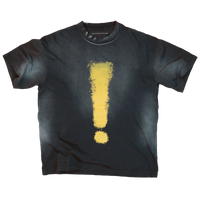
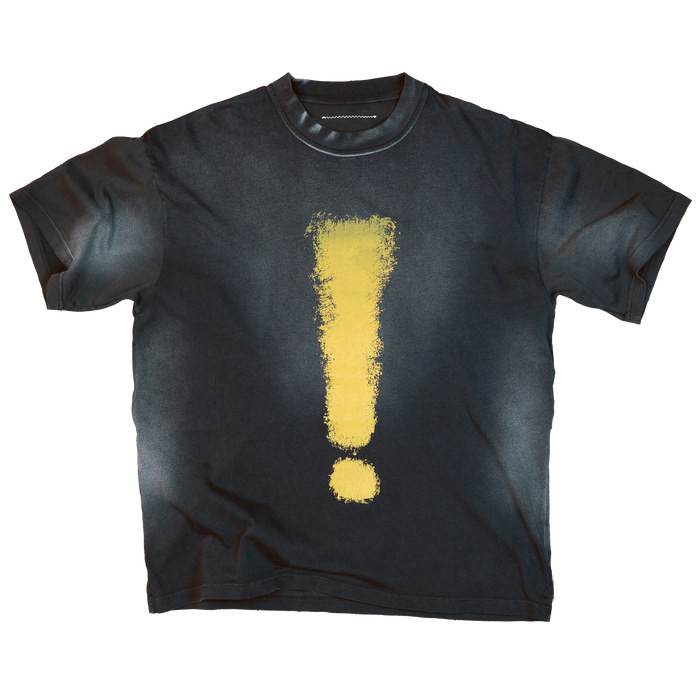
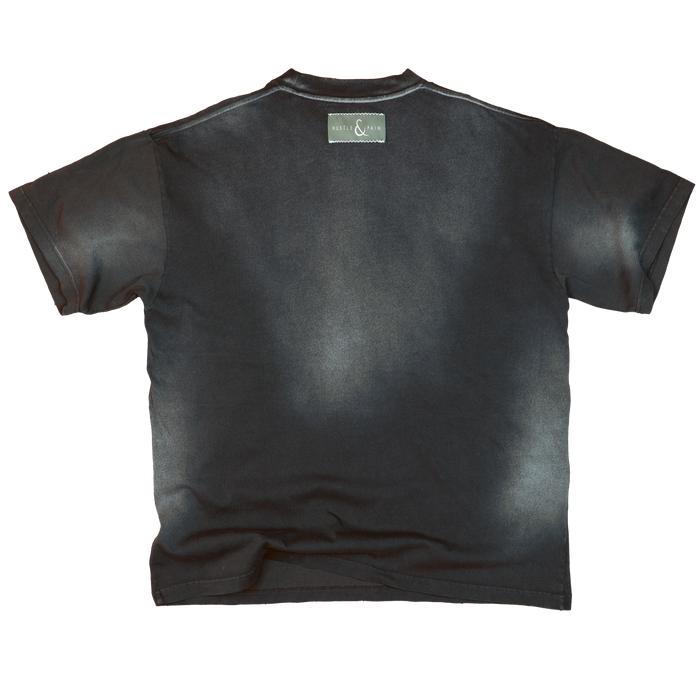
250 GSM: ENERGY in Washed Black, a relaxed cut with a Heavy Vintage Wash and a yellow exclamation mark in screen print. Heavy enough for shape, light enough that the loose cut falls instead of standing.
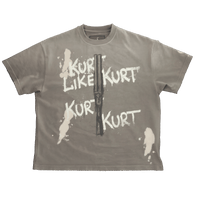
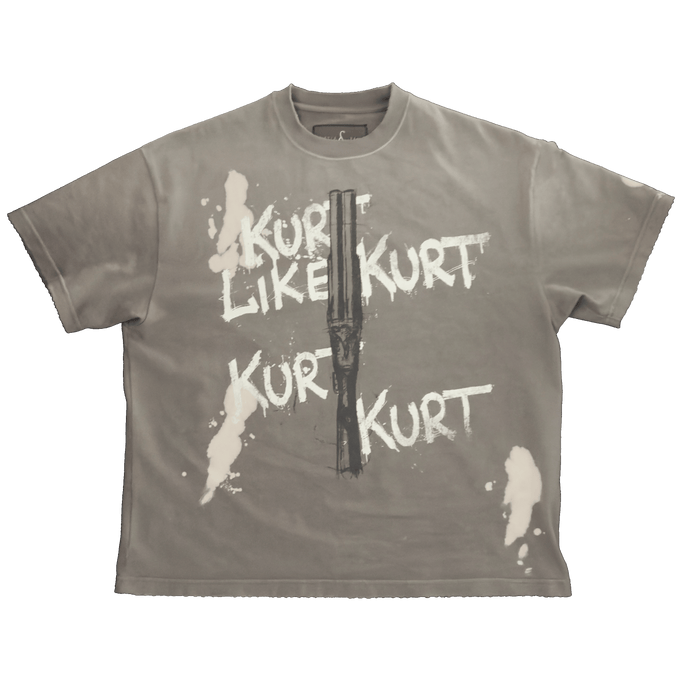
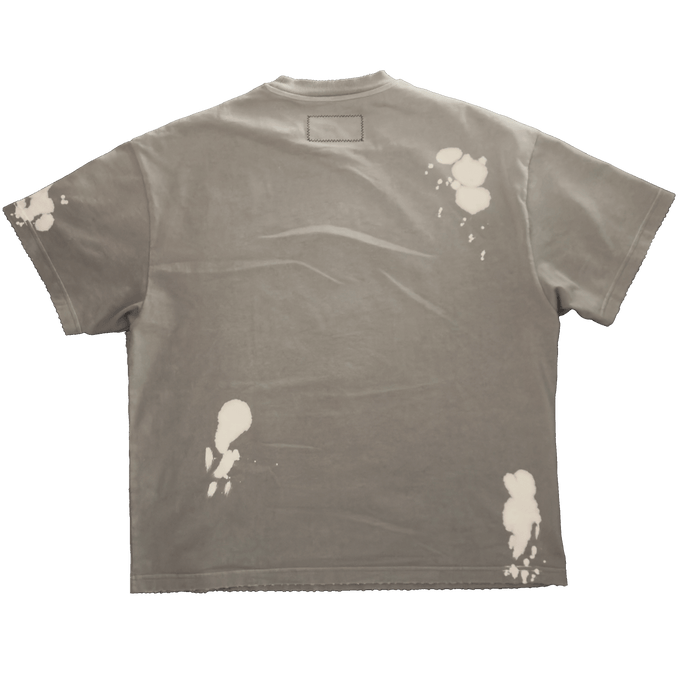
300 GSM: seven shirts, all cut wide. Our Oversized T-Shirts are LIKE KURT in grey with a sun-faded wash, ANTAGONIST in Vintage White with pink lettering, SHOTTIE in black and YOKO ONO, extra long in a kimono cut with no shoulder seam. LAW OF ATTRACTION, with its MONEY NEEDS ME lettering, is boxy oversized, and FUGITIVE and PRICE OF FAME are boxy. The heavy shirts, ENERGY included, are under Heavyweight T-Shirts.
Printer paper folds, card stands. T-shirts are no different.
Sources18
- Wikipedia: Grammatur (German)
- Online Clothing Study: What is GSM Cutter? (23 July 2017, English)
- DIN: DIN EN 12127, Bestimmung der flächenbezogenen Masse unter Verwendung kleiner Proben (standard entry, English)
- DIN Media: DIN EN ISO 139:2011-10, Normalklimate für die Probenvorbereitung und Prüfung (German)
- Wikipedia: Cotton (English)
- Printful: Wie viel wiegt ein T-Shirt? (German)
- SANVT: Heavyweight vs Lightweight T-Shirts (5 August 2021, English)
- Gildan: Heavy Cotton Adult T-shirt G5000 (English)
- Custom Ink: Hanes Beefy-T Crewneck T-shirt (English)
- Represent: Initial Boxy T-Shirt (English)
- Wikipedia: Ounce (English)
- Wikipedia: Square yard (English)
- Wikipedia: Units of textile measurement (English)
- Wikipedia: Open-end spinning (English)
- Wikipedia: Combed cotton (English)
- Wikipedia: Jersey (fabric) (English)
- Loopwheeler: About us (English)
- Highsnobiety: Jeremy Allen White and The Case For an Expensive White T-Shirt (16 July 2024, English)
From the article
Keep reading
-
 Style11 minWhat Is Gothic Streetwear?
-
 Style13 minWhat Goes with a Black T-Shirt?
-
 Style13 minWhat Goes with a Grey T-Shirt?