How to Tell If a T-Shirt Is High Quality?

Quick answer
A €4 sports shirt from Decathlon did well in a wash test. A €10 H&M shirt in the same test shrank by more than eight per cent. So you spot a high-quality T-shirt less by its price than by long, combed cotton, a densely knitted fabric, side seams that run straight down, a collar that springs back the moment you stretch it, and a cleanly double-stitched hem. You can check most of it in the shop in a minute, the rest after the first wash.
Quick questions
Are expensive T-shirts better?
Often, but not always. In the Que Choisir test, two shirts at around €50 each came out on top, yet a €4 Decathlon shirt still did well.
Which is better: Pima, Supima or Egyptian cotton?
All three stand for long fibres of the species Gossypium barbadense. Supima is the trademark for American Pima. After that, how good the shirt turns out depends on yarn and construction.
How many GSM should a high-quality T-shirt have?
There is no fixed number. Heavy streetwear shirts usually sit at 240 to 300 GSM, but a dense light fabric can outlast a loose heavy one.
Why does a T-shirt twist after washing?
Because the twist in the yarn loosens in the wash and the fabric was cut off-grain. The technical term is spirality.
Ten points at a glance
- Fibre: long, combed cotton, ideally with a variety name
- Fabric: densely knitted, no light between the loops
- Side seams: vertical, from armpit to hem
- Hem: double stitch or coverstitch
- Shoulder and neck: a tape sewn into the seam
- Collar: dense rib knit, springs straight back
- Print: stretches with the fabric and sits straight
- Label: fibre and care, good brands say more
- First wash: barely shorter, no twisted seam
- Price: fits the fabric and construction, not the logo
In detail: the test, the fibre, the seams
The test was run by the French consumer magazine Que Choisir, and Stiftung Warentest (Germany's consumer-testing foundation) took over the results in November 2025: 22 black cotton shirts, eleven for men and eleven for women. The two best cost around €50 each. So paying more helps. It guarantees nothing.
Cotton: what is behind “100% cotton”
The three-pack from the discounter says 100% cotton. So does a €110 shirt. The label doesn't tell you which cotton is in there.
Most of the world harvest is upland cotton (Gossypium hirsutum), with fibres 25 to 30 millimetres long. The long varieties belong to a different species, Gossypium barbadense, which makes up only a small part of the harvest. From 35 millimetres, the International Cotton Advisory Committee speaks of extra-long staple cotton, ELS for short. Long fibres can be spun finer and stronger, because each fibre is twisted into the yarn over a greater length and fewer ends stick out.
- Pima: named after the Pima people of Arizona, officially American Pima in the US since 1970. But cotton from Peru, Australia and Israel is also sold under that name.
- Supima: a trademark created by farmers in the south-west of the US for products made from American Pima. So Supima means Pima from the US.
- Egyptian cotton: also Gossypium barbadense, traded under variety names such as Giza, and known in German as Mako.
If a name like that is on the label, it is a good sign. It isn't proof. In August 2016, the US chain Target took Fieldcrest bedding off its shelves that had been sold as Egyptian cotton. According to Target, the supplier Welspun had been using other cotton since 2014.
The yarn matters almost as much as the fibre. With combed cotton, the fibres pass through fine combs before spinning and the short ones fly out. Ring-spun yarn is twisted tighter and is smoother than quickly spun open-end yarn, which feels drier.
Fabric: hold it up to the light, pull it sideways
The weight in GSM, grams per square metre, tells you how the fabric drapes and whether it shows through. The number is no seal of quality: a loosely knitted 300 made from short fibre can bag out faster than a dense 180. Everything about the numbers is in What Does GSM Mean for T-Shirts?
In the shop, density is what counts:
- Against the light. Small points of light between the loops show a loose knit, even in a heavy fabric, because weight can also come from thick yarn.
- Pull it sideways. Stretch a hand's width of fabric and let go. Dense jersey lies flat again at once, because tight loops hold each other in place. If the spot stays bulged, it will look exactly like that on your chest after a year.
- Flat hand. Lots of fine hairs on the outside are short fibres on their way out. They turn into pills.
If you're after a men's T-shirt in a heavy quality (the same goes for women), jersey starts to feel properly firm from around 220 GSM. You'll find our heavy shirts under Heavyweight T-Shirts.
Seams: side seam, tube, double stitch
Side seam or tube?
Jersey comes off the circular knitting machine as a tube. If the body is cut straight from it, the shirt has no side seams. You find that at both ends of the price scale: on cheap blanks, because two fewer seams save time, and on expensive loopwheel shirts from slow-running circular knitting machines.
On shirts with side seams, the front and back panels are cut separately. That allows cuts like boxy or oversized with a dropped shoulder. Take the shirt by both shoulders and let it hang: the side seam should run vertically from armpit to hem. If it already pulls diagonally forwards in the shop, the fabric was cut off-grain, and every wash makes it more obvious.
Hem and sleeves: double stitch or coverstitch
A good hem shows two parallel rows of stitching on the outside and a web of threads on the inside that covers the cut edge. That is a coverstitch, often called a double stitch on product pages. It stretches with the jersey. A single straight row of stitching barely does, and when you pull the shirt on over your shoulders, the first stitches go right there.
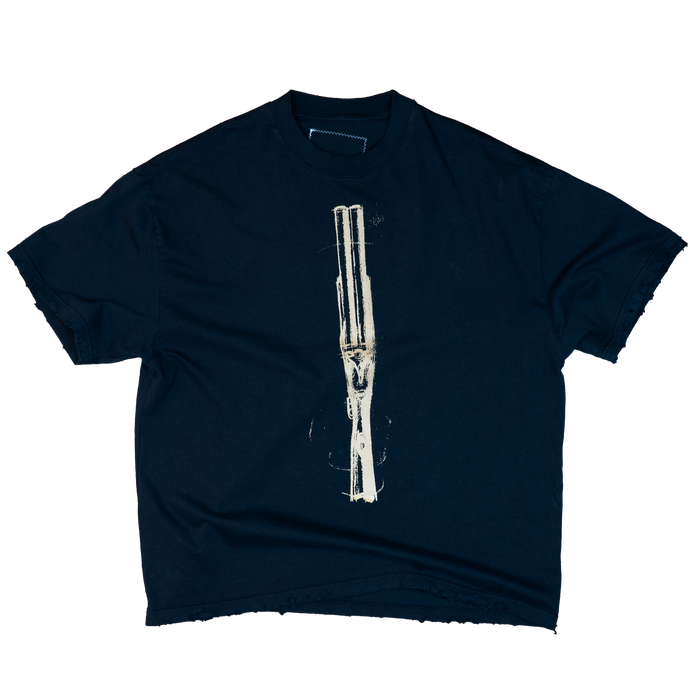
Frayed hems are sometimes deliberate. On our shirts, LIKE KURT, SHOTTIE and ART OF LIFE have distressed hems, and DIRT MOUTH has open raw hems. Intent is stated in the product description and looks similar on every shirt of that model. Sloppy work is random: a single open spot on the shoulder, a thread hanging out of the collar.
Shoulder and neck: the tape in the seam
The whole shirt hangs from the shoulder seam, and even more so when it's wet on the line. Good manufacturers sew a narrow tape into it so the seam keeps its length and the shoulder doesn't bag out. On the inside of the neck, a second tape often covers the seam from shoulder to shoulder and keeps the back of the collar in shape. From the inside you feel both as a firm, smooth strip. With YOKO ONO the question doesn't arise: the kimono cut has no shoulder seam at all.
Collar: pull it and count to one
The collar is usually the first thing to give up, because it gets pulled over your head every morning. Almost every T-shirt collar is made of rib knit, which stretches and contracts like a cuff.
Pull the neck opening as wide as you would putting the shirt on, then let go. A good collar lies flat and round again at once. If it stays stretched or ripples, it gets worse with every wash. Then the width: even all the way round, the seam at the back exactly in the middle. Anyone facing you sees the collar. Nobody sees the side seam.
Print: telling screen print, DTG and DTF apart
On a graphic tee, the best fabric doesn't help much if the print crumbles after ten washes. Screen printing pushes ink through a fine mesh. DTG (direct to garment) prints onto the fabric like an inkjet printer. DTF (direct to film) prints onto a film that is pressed onto the shirt.
- Run your thumb over it: a slightly rubbery layer with an edge you can feel is usually screen print, a smooth, thin skin more likely DTF, and next to nothing to feel more likely DTG.
- Stretch it slightly: if fine white cracks show up already in the shop, the layer of ink is too thick or wasn't cured properly.
- Check the placement: the motif sits straight and centred, and two colours meet without a sliver of fabric showing between them.
Our motifs are screen printed, except YOKO ONO, which has embroidery on the back instead of a print. How screen print, pigment dye and color splash work together on one shirt is covered in T-Shirt Finishing: Pigment Dye, Color Splash and Screenprint.
Label, certification, origin: what has to be on it and what doesn't
In the EU, one thing above all is mandatory: the fibre composition, listed by share and, for goods sold in Germany, in German. That is what the EU Textile Labelling Regulation (EU) No 1007/2011 says. Care symbols are voluntary, and so is the country of origin. And a “Made in” names one country but usually doesn't tell you where the cotton was grown or where it was knitted and dyed.
OEKO-TEX Standard 100 stands for testing for harmful substances. Whether the collar still lies flat after ten washes, the certification won't tell you.
Good brands volunteer more: GSM, yarn, wash, the country where it was sewn. The more is missing, the more you have to check yourself.
High-quality T-shirts tested: what the washing machine reveals
At Que Choisir, the shirts went through the machine five times according to their labels (report by Stiftung Warentest). Then they measured whether the shirts had shrunk or bagged out and whether seams had twisted. After 15 rounds of washing, drying and ironing, they checked fluff, edges and colour.
- Very good: American Vintage and Armor Lux, around €50 each
- Good: the men's shirt Domyos 100 Sportee from Decathlon for €4 (per its label, to be washed very gently; washed less gently, it shrank only slightly)
- H&M Loose Fit, €10: shrank by more than eight per cent after a few washes
- Primark, €3.50: tore much earlier than the others, with a hole after 15 washes
- Adidas: the side seams under the arms twisted
In its reply, H&M said that shrinkage of up to five per cent after five washes was acceptable.
There is also an older test of women's T-shirts. In 2010, Stiftung Warentest tested 39 women's shirts priced between €2.99 and €40 and put the result in the headline: “Not much quality”. Loose seams, damaged knit, bagged out and faded after a few washes, flaking prints.
Price and quality: cost per wear, honestly calculated
Cost per wear means: the price divided by the number of times you wear a shirt. Mostly it is used to make an expensive shirt look better value than it is. With the test prices that doesn't work: the €3.50 Primark shirt with a hole after 15 washes costs just over 23 cents per wear if you wash after every wear. A €50 shirt has to be worn more than 200 times to keep up.
The catch: the sum counts days, not whether you enjoy wearing the shirt on those days. One that hangs crooked after five washes stays in the wardrobe, even without a hole. The Decathlon shirt, on the other hand, shows that a cheap shirt can last. For sport that is an honest choice. Under a leather jacket, you'd rather have weight, drape and a motif.
The 60-second test in the shop
- Read the label, 10 seconds. A brand that buys long fibre will write it down.
- Backlight and sideways pull, 10 seconds. Loose knit warps first.
- Stretch the collar, 5 seconds. It has to put up with the most in everyday wear.
- Let it hang from the shoulders, 10 seconds. A diagonal side seam only gets more diagonal after washing.
- Turn the hem over, 10 seconds. A single row of stitching tears when stretched.
- Feel the shoulder, 5 seconds. The tape keeps the shoulder at length.
- Stretch the print, 10 seconds. What cracks in the shop won't survive the washing machine.
Online the same list applies, just with a zoom on hem, collar and print.
The test after the first wash
Cotton shrinks mostly in the first few washes. That is why a tape measure is worth having.
- Measure before. Lay it flat, measure the length from the highest point of the shoulder to the hem and the width a hand's breadth below the armpits. Take a photo of the side seam, because without a before picture you have nothing to compare.
- Wash the way we recommend. Inside out, because otherwise the print rubs against the drum. 30 °C, because cotton shrinks more in hot water. No tumble dryer, because nowhere does it shrink as much as there.
- Dry flat, measure again. Flat, because a wet shirt on a hanger gets pulled longer, which flatters the result.
Shrinkage: how much is normal?
Take H&M's own limit: five per cent at most. On a length of 75 centimetres, that is just under four centimetres.
Twisted side seam: spirality
If the side seam wanders towards your belly button, the shirt has twisted. Test labs call this spirality and measure it to a standard of its own, ISO 16322. The fault is built in before the shirt reaches the shop: cotton yarn is twisted, and the twist wants to release. If the fabric wasn't cut exactly along the loops, the water releases the tension and the shirt shows how crookedly it was cut. Ironing helps for a day. You can't wash it out.
High-quality T-shirts for men and women: our shirts against the checklist
The list is the same for men and women, the difference lies in the cut: with unisex shirts, look at where the shoulder seam sits and where the hem ends. Boxy shirts like FUGITIVE or PRICE OF FAME are a little shorter than our Oversized T-Shirts. How the cuts differ is covered in Boxy vs. Oversized vs. Slim Fit.
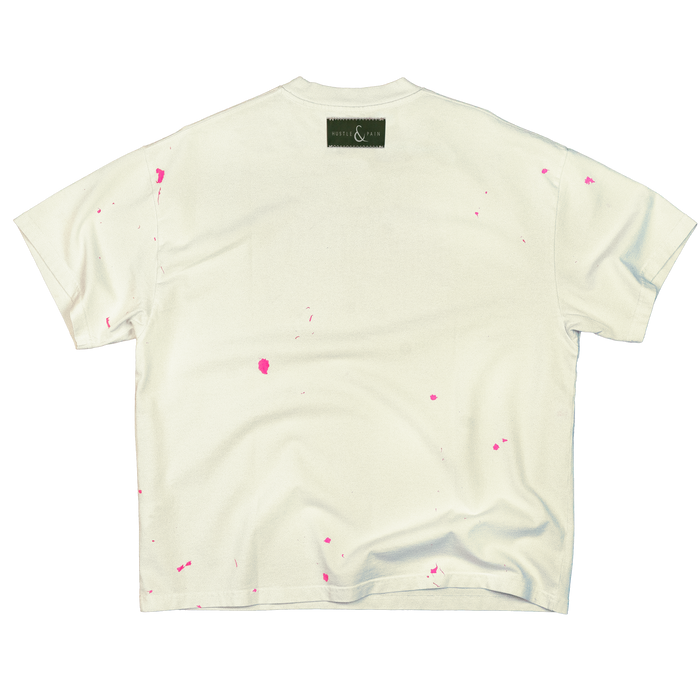
All our shirts are unisex and made of 100% cotton. Seven are 300 GSM, ENERGY is 250, DIRT MOUTH is 180 in ring-spun yarn, ART OF LIFE is 150 in ring-spun, combed organic cotton. Almost every shirt is finished by hand, meaning washed, bleached or distressed, and small differences between two pieces come with that. ANTAGONIST, made in Portugal, is deliberately Vintage White rather than snow white, with pink lettering and pink paint splashes.
What we don't promise: that a shirt lasts for ever. It lasts longer if it goes into the machine inside out at 30 °C and is then air-dried, never tumble-dried. You'll find all the cuts in our high-quality T-shirts for men and women.
A €4 shirt can pass the wash test and a €10 one can fail. The tape measure is equally honest with both.
Sources6
- Stiftung Warentest: T-Shirts im Test, von ausgezeichnet bis eingelaufen (29 November 2025, in German, test by Que Choisir)
- Stiftung Warentest: T-Shirts für Frauen, wenig Qualität (29 July 2010, in German)
- Target: Statement on Welspun Global Brands (August 2016)
- Verordnung (EU) Nr. 1007/2011 über Textilfaserbezeichnungen (EUR-Lex, in German)
- Wikipedia: Pima cotton
- Wikipedia: Egyptian cotton (Gossypium barbadense)
From the article

Keep reading
-
 Style11 minWhat Is Gothic Streetwear?
-
 Style13 minWhat Goes with a Black T-Shirt?
-
 Style13 minWhat Goes with a Grey T-Shirt?