What Is Garment Finishing on T-Shirts?

Quick answer
A pair of jeans that has spent a summer in sun and salt water looks different from a new pair, and plenty of people want exactly that difference from day one. Garment finishing follows the same idea, just with more control: it covers everything that still changes a shirt after the fabric is knitted, from dyeing, bleaching and washing to print and embroidery. Pigment dyed means coloured with pigment, Color Splash means splashes of colour placed on purpose, and bleach takes colour out of the fabric until pale patches are left.
What does pigment dyed mean?
Coloured with pigment: the colour consists of insoluble particles that a binder holds on the fibre instead of letting them soak in. That’s why the shade gets a little lighter with every wash, first at the edges and seams.
What is the difference between garment dyed and pigment dyed?
Garment dyed describes the timing: sewn first, dyed afterwards. Pigment dyed describes what the colour is made of, and a shirt can be both, though it doesn’t have to be.
Do bleach stains come out in the wash?
No, the bleach has destroyed the dye at that spot. With colour detergent at 30 °C, the dark fabric around it stays as it is too.
Is embroidery more durable than print?
Embroidery can’t crack or crumble like an old layer of print, but its stitches can snag on Velcro or zips. A screen print mostly cracks early when the ink wasn’t fully cured.
Can you make a bleach T-shirt yourself?
Plenty of people do, but you won’t get a recipe from us. Chlorine bleach irritates skin and airways. With vinegar or other acids it forms toxic chlorine gas, and with ammonia, toxic chloramines.
Garment finishes at a glance
- Garment dye: sewn first, dyed after, tone-on-tone at the seams
- Pigment dye: the colour sits on the fibre and fades on purpose
- Color Splash: splashes of colour by hand, different on every shirt
- Bleach: takes the colour out, the marks stay
- Sun faded: the look of years in the sun, created in the wash
- Marble and dirt wash: clouds like marble, or a grey haze
- Distressed and raw edges: open edges that curl up
- Screen print, metallic, puff print: ink you can feel
- Embroidery: thread instead of a layer of ink
- Care: inside out, 30 °C, no tumble dryer
In detail: colour in, colour out, edges open
Product pages tend to use these terms without explaining them, and two brands can mean two different processes when they say sun faded. Here is how each technique looks, how it ages and how it wants to be washed.
Textile finishing: five ways to change a shirt
In the trade, everything fabric goes through after knitting or weaving is called textile finishing: pretreatment such as washing and bleaching, dyeing, printing and functional finishes. In streetwear, washes and embroidery count too. Sorted by what happens to the colour, there are five groups:
- Colour in: garment dye, pigment dye, Color Splash
- Colour out: bleach in all its forms, sun faded
- Washes: vintage wash, marble wash, dirt wash
- Edges open: distressed hems, raw edges
- Something on top: screen print, metallic, puff print, embroidery
The techniques can be stacked, and every one of our shirts carries at least two.
Garment dyed: sew first, dye later
Cotton can be dyed as loose fibre, as yarn, as fabric off the roll or as a finished, sewn garment. With garment dyeing it happens right at the end: the shirt is sewn from undyed fabric and then goes into the dye bath whole.
You can see it. Where different materials meet or layers of fabric overlap, at the collar, seams and hem, the shirt takes the colour differently from the flat areas, and tone-on-tone effects appear. Polyester sewing thread often keeps its own colour, because polyester is dyed with entirely different dyes from cotton.
One of the first to make dyeing finished pieces his signature was Massimo Osti from Bologna, founder of C.P. Company and, in 1982, of Stone Island. At C.P. Company, garment dyeing became the label’s calling card.
Pigment dyed: meaning and why the colour fades
Pigment dyed means coloured with pigment. A dye dissolves in water and soaks into the cotton fibre. A pigment is practically insoluble. It is made of tiny solid particles of colour, which a binder encases and glues to the fibre. So the colour sits on the outside of the fibre, and everything else follows from that:
- The shade is slightly uneven from day one, dusty rather than rich.
- Every wash and every bit of friction takes some colour with it, first at the edges, seams and creases, because that’s where the fabric rubs most.
- After a year, the shirt is lighter and softer in contrast than the day you bought it.
So garment dyed tells you when the dyeing happens. Pigment dyed tells you what with. A shirt can be both, though it doesn’t have to be. Pigment print is something else again: pigment-based printing ink, only on the design.
Color Splash: splashes of colour on purpose
In the late forties, Jackson Pollock laid canvases on the floor of his studio in Springs, Long Island, and let paint drip onto them from sticks and stiff brushes. Color Splash follows the same physics: round drops, long streaks, a fine mist, and the shape tells you where the paint came from.
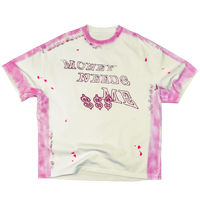
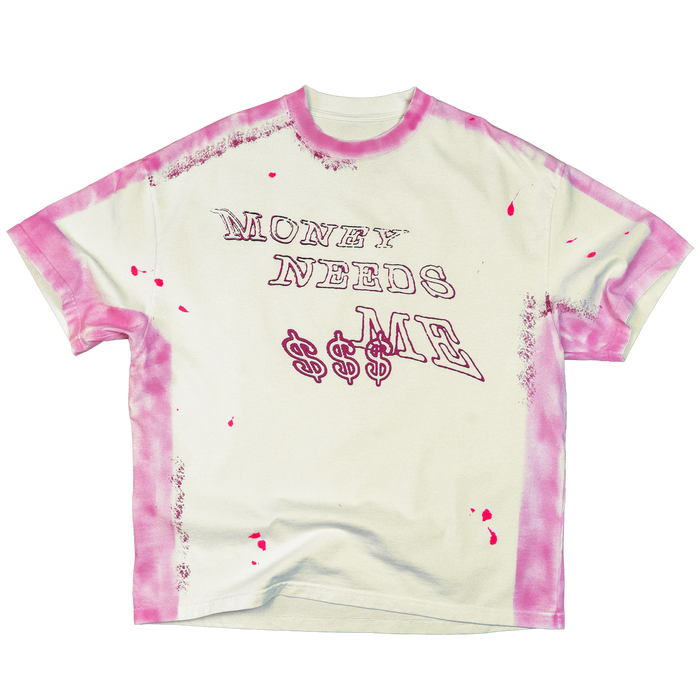
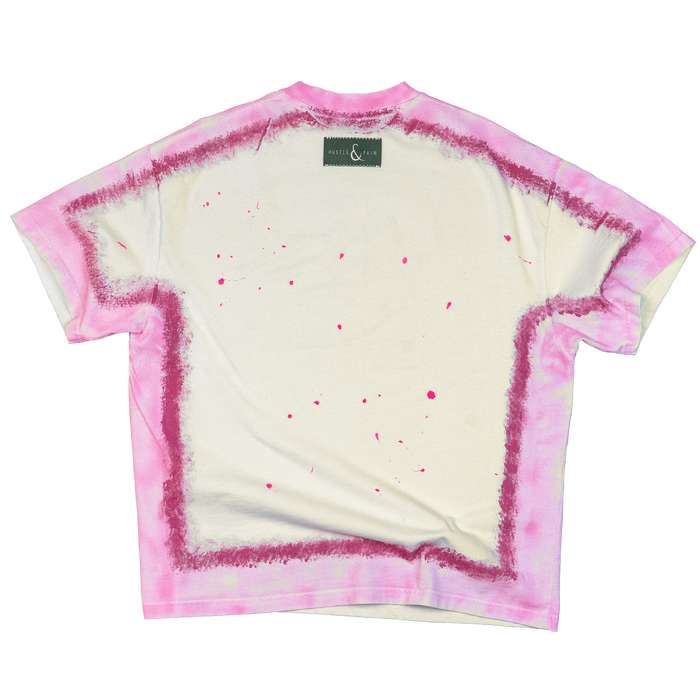
We place the splashes by hand, so no two shirts have them in the same spot. On LAW OF ATTRACTION they are single pink drops, plus pink edges at the collar, shoulder seams, sides and sleeve hems, also painted by hand. On ANTAGONIST they are fine pink spatters front and back. Properly fixed, splashes last about as well as a print and at most turn a little duller over the years. Printed splashes exist too. From a distance they look similar. How to tell them apart up close is covered further down in the four tests.
Bleach T-shirts: splatter, tie-dye and why black turns red
Bleach works the other way round. It destroys the dye, and what’s left is roughly the colour of raw cotton. Roughly, because dark shirts rarely turn white: on most black cotton shirts, orange, rust or a light brown comes through, depending on what the manufacturer dyed them with.
In the early eighties, punks and skinheads splashed bleach onto their jeans on purpose. On T-shirts today there are three main forms:
Bleach splatter means spatters and drops on dyed cotton. On PRICE OF FAME in Faded Concrete, each shirt is bleached individually, so the marks land somewhere different on every one, front and back. Up close they are almost white, with a fine pink rim.
Bleach tie-dye reverses tie-dyeing: the dark shirt is twisted and tied, then bleach goes on, and the tied-off parts stay dark. In German this is often called Batik, though batik is really the wax technique from Java, and the tying technique has names of its own, such as shibori.
Bleached stripes, as on FUGITIVE: the grey and black stripes are bleached and given an acid wash. That makes them look irregular and faded.
Bleach marks never come out again, because the colour at that spot is gone. Bleach also attacks the cotton itself. If it isn’t stopped in time, it keeps breaking down the fibre, and the fabric turns brittle there.
Sun faded: like three summers in a shop window
A shirt that has hung in a shop window or on the washing line for a few summers fades unevenly. UV light breaks down dye wherever it hits, on the shoulders, along the edges and anywhere the fabric lies exposed. Whatever lay in the shade, in folds or under the arm, stays darker. That gradient is what sun faded means.
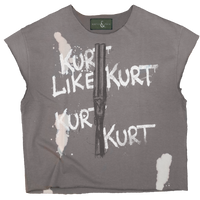
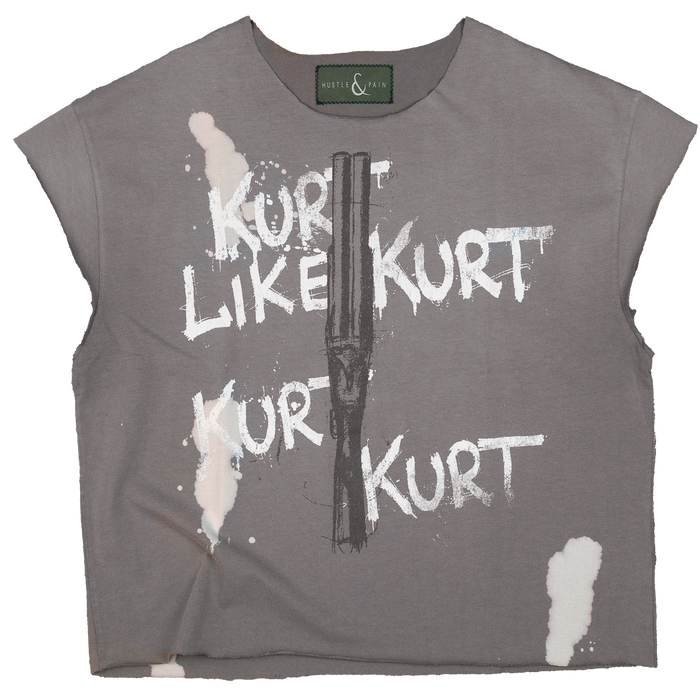
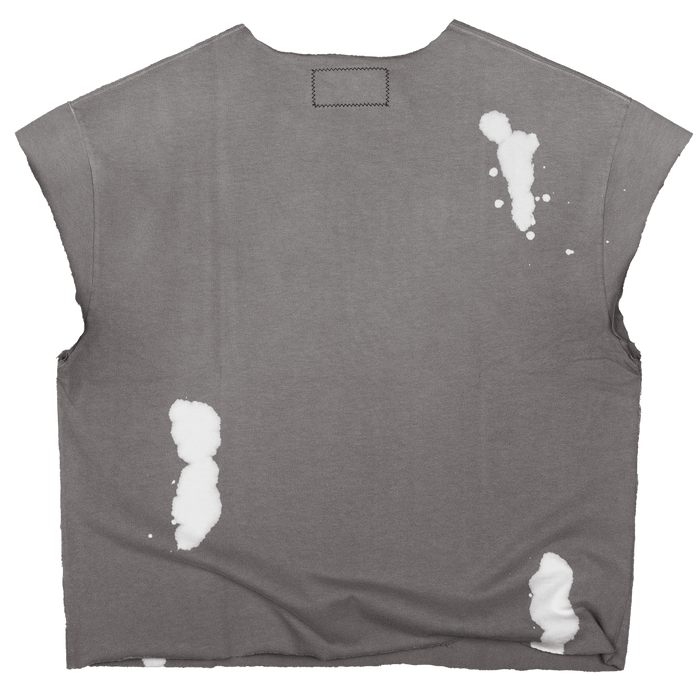
In our range, sun faded is a wash. On LIKE KURT it lightens the grey, with bleached patches front and back on top. PRICE OF FAME combines sun faded with bleach splatter on Faded Concrete, a washed-out concrete grey. Dry shirts like these in the shade, because real sun will otherwise carry on where the wash left off.
Marble wash and dirt wash: clouds and asphalt
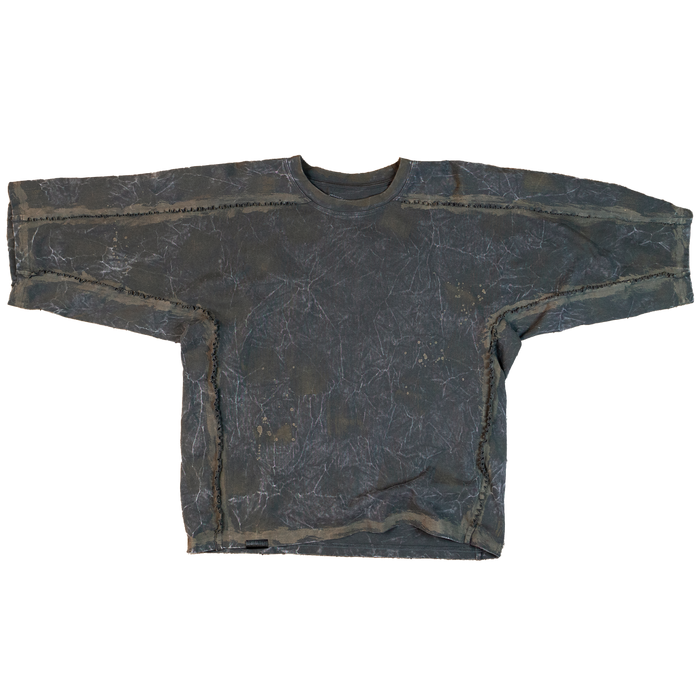
A marble wash turns a single colour into a pattern: pale veins with darker clouds in between, like a slab of marble. Visually it is related to acid wash, whose modern process the Italian jeans brand Rifle patented in February 1986: denim washed almost white with pumice stone and bleach. On YOKO ONO, the marble wash makes the Vintage Grey cloudy. In our range, FUGITIVE has an acid wash.
A dirt wash lays a grey haze over the base colour, as if the shirt had spent a night on the asphalt. On DIRT MOUTH it sits on Eggshell, a warm off-white, which makes it look like a vintage find. No actual dirt is involved, the haze is part of the wash.
A wash is never entirely done: every trip through the machine afterwards makes the fabric softer and the contrast flatter. For more on vintage wash and heavy vintage wash, as on ENERGY in Washed Black, read Vintage Wash T-Shirts. You’ll find all our washed shirts under Vintage T-Shirts.
Distressed hems and raw edges: why jersey curls
In the mid-seventies, Richard Hell, bassist and singer on the New York punk scene, wore torn shirts held together with safety pins. Malcolm McLaren, who had seen Hell in New York, took the idea back to London, to SEX on the King’s Road, the shop he ran with Vivienne Westwood. Ever since, a wrecked edge has been a style choice.
Raw edges, or raw hems, are edges left open after cutting. Distressed means the edge or fabric is also roughed up or lightly torn until it looks like years of wear. T-shirt fabric is usually single jersey, which is knitted, and it curls up at an open edge. That’s why the open sleeve edges on FUGITIVE and PRICE OF FAME are rolled. On LIKE KURT the hem, sleeves and collar are distressed, while DIRT MOUTH leaves its edges raw.
Open edges roll a little more with every wash, and threads come loose where the fabric has been roughed up. Snip loose threads off close instead of pulling them, because otherwise jersey can unravel stitch by stitch.
Screen printing, metallic and puff print: ink you can feel
Every design on our Graphic Tees is screen printed: a squeegee pushes the ink through a fine mesh that is sealed everywhere except the design. Opaque screen-printing ink sits on the fabric as a layer. If it cracks early, it usually wasn’t fully cured. After a great many washes, it eventually cracks and flakes, like an old band shirt.
For metallic prints, metal flakes are mixed into the ink, or an adhesive is printed and a wafer-thin foil is heat-pressed onto it, which only sticks to the design. You don’t iron over either, and that goes for all our prints anyway. On the front of DIRT MOUTH sits a screen print with a metallic effect in the style of grillz, the dental jewellery from hip-hop.
For puff print, an additive goes into the ink that lifts the print off the fabric. The design stands up in relief and feels soft and spongy. On bold letters that looks strong, on fine lines it looks like foam, because details fill in as the ink puffs up. The raised logos on caps, by contrast, are often 3D puff embroidery: dense satin stitches over a piece of foam. None of our current shirts has a puff print.
Embroidered T-shirts: how embroidery works and ages
Embroidery is thread stitched through the fabric. There is no layer of ink to crack or crumble, but thread brings weight and tension to the fabric.
Before stitching, the design is digitised, which used to be called punching: it is translated into a stitch plan that sets which area gets which stitch, and in what order. Letters and narrow borders usually get satin stitch, dense parallel stitches, while large areas get fill stitch. The shirt is clamped in a hoop with a stabiliser behind it, so the jersey doesn’t distort under the needle.
Machine embroidery has a Saxon side to its story. In 1829, Josua Heilmann from Alsace developed the first hand embroidery machine, and in 1863 Isaak Gröbli built the Schiffli embroidery machine in Uzwil, Switzerland. It was the Vogtland that eventually broke the Swiss monopoly: the Vogtländische Maschinenfabrik in Plauen, Saxony, built embroidery machines from its founding in 1881, and later so did Kappel in Chemnitz.
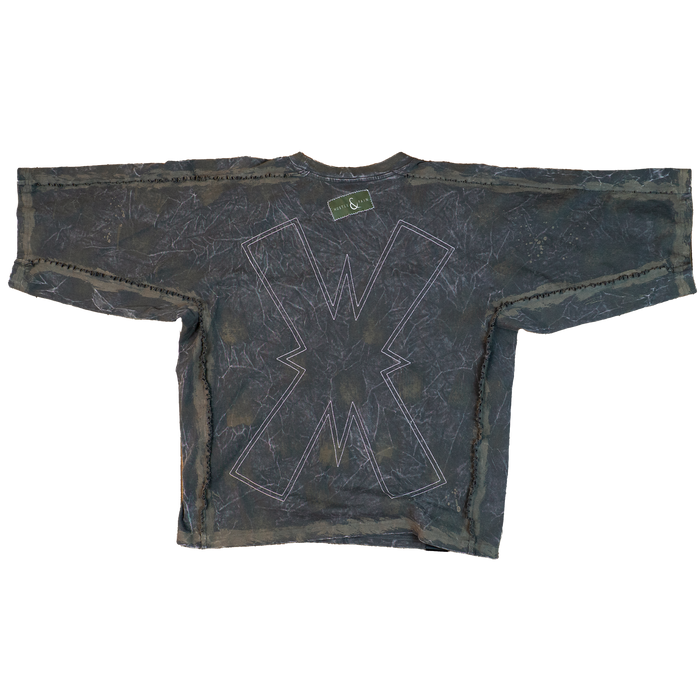
Contrast embroidery means the thread stands out in colour from the fabric. On YOKO ONO, a large shape runs across almost the entire back, only as an outline in light thread with a double stitch line. Because no area is filled in, the back stays soft. A filled area that size would make it stiff and pucker thin jersey. Large embroidery belongs on heavy fabric, more on that in What Does GSM Mean on T-Shirts?
Small and almost everywhere: the embroidered label. Our ZIGZAG label is green, carries HUSTLE & PAIN in light thread and is sewn on top and bottom with a zigzag stitch. It sits at the neck of almost all our shirts.
Real or printed? Four tests for handwork
Patches, splashes and rips can be printed as well. This is how you tell the difference:
- Two shirts side by side. If the patches, splashes and gradients sit in exactly the same place on two shirts of the same size, it’s a print. Handwork lands somewhere different every time.
- Turn it inside out. Bleach goes through the fabric, so a real bleach mark usually shows on the inside too. A printed effect stays on the outside.
- Look at the edge. A real bleach mark has a transition, often a rim in a different shade. A printed one has a clean edge in a single colour and a layer you can feel with your thumb.
- Look for threads. Real distressing has loose fibres and open stitches. A printed worn look is flat.
How do you care for dyed, bleached and printed T-shirts?
The same rule applies to every technique: inside out, 30 °C, no tumble dryer. Here’s why:
- Inside out, because otherwise print, splashes, embroidery and open edges rub against the drum and the zips of other clothes.
- 30 °C, because pigment colour and washes give way faster at higher temperatures.
- No tumble dryer, because heat and friction shrink cotton and rough up open edges.
- Colour detergent, because heavy-duty detergent contains bleaching agents and colour detergent doesn’t, and over time bleaching agents lighten dark areas.
- Similar colours for the first few washes, because pigment-dyed and washed shirts can bleed a little colour at first.
- Iron only from the inside, with a towel underneath for embroidery, because printing ink softens under a hot iron and stitches get flattened.
A pair of jeans needs a whole summer on the beach to fade like that. With garment finishing, the first summer comes built in. The ones after that are yours.
Sources20
- Wikipedia: Textilveredelung (German)
- Wikipedia: Dyeing, dyeing fibre, yarn, fabric and garments (English)
- Wikipedia: Massimo Osti (English)
- Wikipedia: Pigment (German)
- Wikipedia: Jackson Pollock (English)
- Printable Press: How to Do Reverse Tie-Dye on a Black T-Shirt (2026, English)
- Wikipedia: Stone washing, with acid wash and the Rifle patent (English)
- Wikipedia: Batik (German)
- Wikipedia: Lightfastness (English)
- Wikipedia: Punk fashion, with Richard Hell and Malcolm McLaren (English)
- Wikipedia: SEX, the shop of Vivienne Westwood and Malcolm McLaren (English)
- Wikipedia: Jersey (fabric) (English)
- Wikipedia: Screen printing, with metallic, foil and puff (English)
- Wikipedia: Grill (jewelry) (English)
- Rush Order Tees: The Distress Effect, How To Create a Vintage Look (14 November 2022, English)
- Monday Merch: 3D Embroidery, Printing Techniques Explained (English)
- Wikipedia: Machine embroidery (English)
- Wikipedia: Stickmaschine (German)
- Wikipedia: Sodium hypochlorite, safety of chlorine bleach (English)
- Wikipedia: Waschmittel, heavy-duty and colour detergents (German)
From the article
Keep reading
-
 Style11 minWhat Is Gothic Streetwear?
-
 Style13 minWhat Goes with a Black T-Shirt?
-
 Style13 minWhat Goes with a Grey T-Shirt?