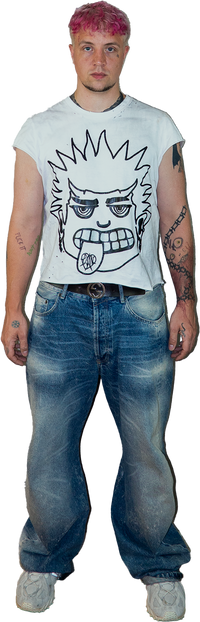
What Is Screen Printing?

Quick answer
Run your thumb over a Nirvana shirt from the early nineties and you’ll feel an edge: a layer of ink all of its own. That’s screen printing. A squeegee pushes the ink through a fine mesh that is sealed off everywhere the design shouldn’t go, and every colour gets its own screen. DTG, by contrast, prints straight onto the fabric like an inkjet printer, and DTF prints onto a film first, which is then pressed onto the shirt.
Screen printing, DTG and DTF at a glance
- Screen printing: ink through a screen, one screen per colour
- Feel: plastisol as a layer you can feel, water-based and discharge barely noticeable
- Strength: rich colour even on black, special inks such as metallic, glitter and puff
- Weakness: expensive set-up, too costly for one-offs
- DTG: inkjet straight onto cotton, from a single piece
- DTF: print on film, pressed on with hot-melt adhesive, holds on more fabrics than DTG
- Durability: a properly cured screen print is very wash-resistant
- Care: inside out, 30 °C, no tumble dryer, never iron over the print
Quick questions
How does screen printing work?
For each colour, a screen is coated with a light-sensitive layer, exposed and washed out until only the design is open. Then a squeegee presses the ink onto the shirt, screen by screen, and in the end it cures in a drying tunnel.
Is screen printing more durable than DTG?
We haven’t found an independent comparison test. A properly cured plastisol screen print is considered very wash-resistant, and DTG providers such as Printful promise crack-resistant prints with the right care.
Can you iron a screen-printed shirt?
Yes, from the inside or with baking paper in between, but never directly over the print. Plastisol goes soft again under heat, which is why screen-printing suppliers such as Lawson advise against ironing the printed area.
Is DTF the same as screen printing?
No. With DTF, the design is printed digitally onto film and pressed on with hot-melt adhesive and heat. With screen printing, the ink goes straight through a screen onto the fabric.
Which streetwear tees are best for daily wear while keeping prints vibrant over time?
Screen-printed tees on heavy fabric. A properly cured screen print is known for standing up well to washing because the ink sits thickly in the cotton, and 250 to 300 GSM cotton barely loses its shape with wear. At HUSTLE&PAIN every printed design is screen printed, and most of our shirts are 300 GSM. To keep the print vibrant: turn the shirt inside out, wash at 30 °C and skip the tumble dryer.
Where can I buy a screen-printed T-shirt in a streetwear style?
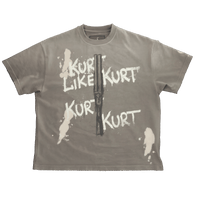
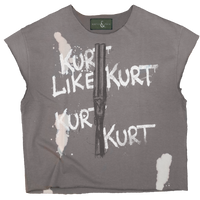
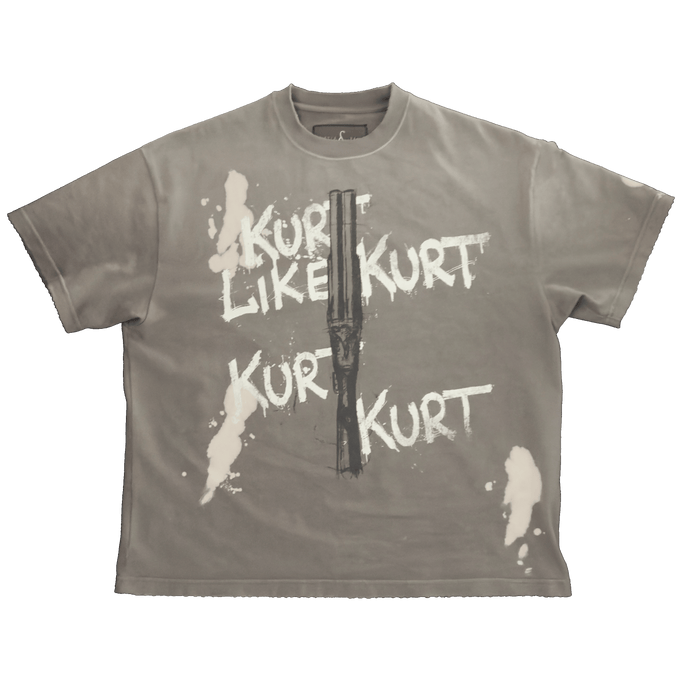
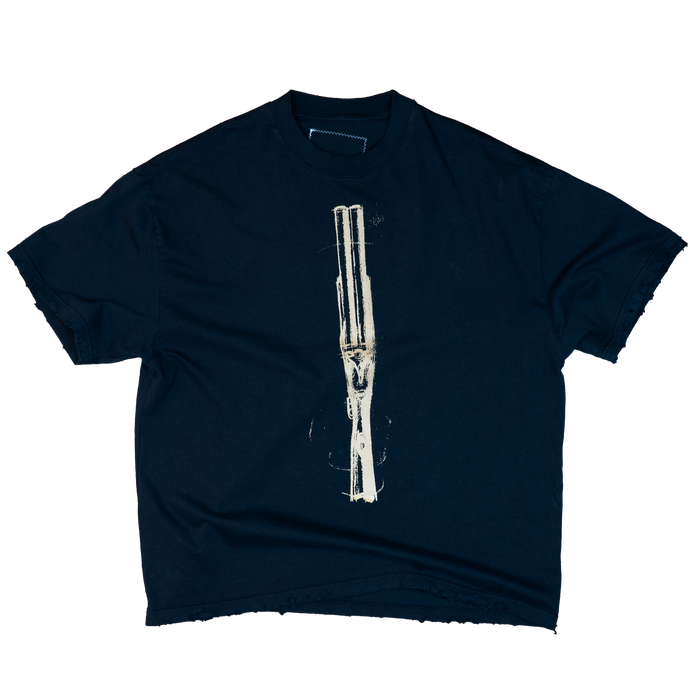
At HUSTLE&PAIN every printed design is screen printed, colour by colour through the screen, mostly on 300 GSM cotton, for example LIKE KURT, ANTAGONIST or SHOTTIE. Shipping within Germany is free and delivery takes 2 to 4 working days.
In detail: screens, ink, history and the competition from the inkjet
For a good twenty years, screen printing has had competition from the inkjet: DTG printers came onto the market in 2004, and DTF spread from the early 2020s. For a single shirt, both are quicker and cheaper. Whether their print will still have an edge in thirty years, one that somebody feels for with a thumb, is another question.
What is screen printing? Frame, mesh, squeegee
It starts with a frame, usually aluminium, sometimes wood in a hobbyist’s basement, with a fine mesh stretched across it. It used to be silk, hence the name silkscreen; today it is almost always polyester. The mesh gets a light-sensitive coating that hardens everywhere there is no design. The mesh stays open only at the design, and that is the stencil.
Mesh fineness is given in threads per centimetre, for textile printing mostly between 30 and 60. A coarse mesh around 30 to 40 lets a lot of ink through, which is what a white needs if it’s supposed to cover black. A finer one around 50 to 60 holds thin lines and halftones.
The squeegee, a polyurethane blade set in a handle, pulls the ink across the screen in one stroke and presses it through the open mesh onto the fabric. Sounds simple. It is, until you try to stack four colours on top of each other to a tenth of a millimetre.
How does screen printing work? Step by step onto the T-shirt
- Separate the colours. The design is split into single colours on a computer. Each colour goes onto a clear film, the film positive, as a deep black area.
- Coat the screen. The degreased mesh is coated with photo emulsion and dried in the dark.
- Expose. Film on the screen, UV light on top. Where light gets through, the emulsion hardens. Under the black design it stays soft.
- Wash out. Lukewarm water rinses out the soft emulsion. Only the design stays open.
- Set up. The screens go into a carousel press, one per colour, lined up exactly. A few millimetres of air between screen and shirt, the off-contact distance, make sure the mesh lifts away from the fresh print straight behind the squeegee.
- Print. On dark shirts, a white underbase goes down first and is briefly dried under a flash dryer. The colours follow, station by station.
- Cure. Finally, the shirt runs through a drying tunnel. Plastisol, the most common ink for textile printing, only really cures at around 143 to 166 °C, according to the US screen-printing supplier Lawson. If it’s too cool or goes through too fast, it comes back to bite you a few washes later.
Steps one to five happen once per design, whether 30 or 3,000 shirts follow. That’s why screen printing on T-shirts is absurdly expensive for a single piece and cheap at a hundred.
Plastisol, water-based, discharge: the ink decides the feel
Plastisol is the standard in textile print shops: PVC particles in a plasticiser, no water at all. The ink doesn’t dry in the screen, covers strongly and wraps around the fibres instead of dyeing them. Cured, it is flexible and slightly rubbery. That is the print you know from tour shirts.
Water-based ink soaks into the fabric instead of forming a thick layer on top. The print feels soft. Classic water-based inks are mostly used on light cotton, and for dark shirts there are more opaque formulations.
Discharge goes the opposite way. An additive in the ink pulls the dye out of the cotton, and on a black shirt a lighter tone is left behind. You feel next to nothing, and it suits prints with a worn-in look especially well. It only works properly on dark shirts made of 100% cotton, and because every dye gives way by a different amount, not even the printer knows the exact shade beforehand.
So anyone who claims you can always feel screen printing has only ever held plastisol.
History of screen printing: from flour sieves to Andy Warhol
Stencil printing had existed in East Asia for a long time, in Japan for example as Ise-katagami. The screen arrived by a detour. In 1830, Pierre Antoine Dufour began weaving silk gauze for flour sieves in Thal in the canton of St. Gallen, commissioned by the Zurich silk entrepreneur Heinrich Bodmer. Sefar, today a Swiss manufacturer of screen-printing mesh, goes back to that business, and the Historical Dictionary of Switzerland tells the story too. It was above all the Swiss gauze makers who promoted screen printing in the USA from the late 1910s, because it opened up a new market for their gauze.
In the early 1910s, printers experimented with light-sensitive chemicals, the basis of today’s photo stencil. In the 1930s, a group of American artists around Anthony Velonis gave the process the name serigraphy, after the Latin sericum for silk, to set their art apart from industrial printing. Silk stayed in use until the 1950s, then polyamide and polyester took over.
In 1962, Andy Warhol made screen printing famous in art. His “Marilyn Diptych” shows Marilyn Monroe fifty times, colourful on the left, in black and white on the right, fading bit by bit, and it now hangs in the Tate Modern in London.
For T-shirts the turning point came at almost the same time. In 1960, the American Michael Vasilantone began building and selling a rotating press for several colours, meant for bowling shirts, and received the patent in 1969. It was licensed to several manufacturers, and the machine brought the boom in printed T-shirts. Then came band merch, surf and skate labels, in the early eighties Stüssy with the signature of a surfboard shaper from Laguna Beach, and in 1994 Supreme in New York. Almost every graphic tee from that era is screen printed, because DTG printers only came onto the market in 2004.
Pros and cons of screen printing: rich colour, expensive start
What screen printing can do:
- Rich, opaque colours, including a white on black that really is white
- Colours that are mixed exactly as spot colours, instead of converted from a printer profile
- Special inks such as metallic, glitter and puff, an ink that lifts the print into three dimensions
- A print that, properly cured, is very wash-resistant
Where it falls short:
- Every colour costs its own screen and its own set-up, so a design with ten colours gets expensive
- Photos and soft gradients only work through halftones, meaning dots
- Not worth it for one-offs
- Plastisol sits as a layer on top of the fabric, and large areas make it stiffer at that spot
What is DTG printing? The inkjet for shirts
DTG stands for Direct to Garment. In principle it is a large inkjet printer: the shirt lies stretched on a platen, and the print heads spray water-based ink straight onto the fabric. Well-known machines come from Kornit, Epson and Brother. Beforehand the shirt is pretreated so the ink holds better on the fibre, which matters above all for white on dark shirts.
The strength of DTG: no screens, no set-up. A one-colour logo and a photo with thousands of shades are about the same work for the machine, which is why print-on-demand providers such as Printful use it, with no minimum order. The weakness: DTG wants cotton. Printful only prints on fabrics with at least 50% cotton, and on polyester, it says, the print often doesn’t hold well and soon looks faded.
What is DTF printing? The detour via film
DTF stands for Direct to Film. The print goes onto a PET film first: the design in mirror image in colour, with a layer of white over it. A fine powder of hot-melt adhesive goes onto the still-tacky ink and is melted on. A heat press presses the whole thing onto the shirt at 160 to 170 °C for 10 to 15 seconds, then the film is peeled off (Wikipedia). What’s left is a film carrying the design, stuck to the fabric.
DTF needs no pretreatment and holds on more fabrics than DTG. The transfers can be printed in advance and pressed on later. Since the early 2020s, more and more small and mid-sized print shops have been using it, and big manufacturers are now building their own machines too.
The catch is the feel. A DTF print feels like plastic sitting on the fabric rather than fusing with it, and you shouldn’t iron directly over it.
Screen printing vs digital printing: DTG and DTF compared
- Feel: Screen printing, depending on the ink, from clearly noticeable (plastisol) to barely noticeable (water-based, discharge). DTG is soft, as the ink soaks into the fibre. DTF is like a layer of plastic on top.
- Colours on black: Screen printing with plastisol is opaque. DTF too, because there is always white underneath. DTG needs pretreatment and a white base layer for that.
- Photos and gradients: DTG and DTF without a detour, screen printing only as halftones.
- Metallic, glitter, puff: Screen printing, with its own special ink.
- Fabrics: Screen printing with the right ink on many fabrics. DTG at Printful from 50% cotton. DTF on more fabrics than DTG.
- Quantity: Screen printing only pays off with several shirts per design, DTG and DTF from a single piece.
- Durability: Lawson calls the wash resistance of properly cured plastisol excellent, and Printful promises crack-resistant prints for DTG. We haven’t found an independent comparison test.
Sublimation, the fourth technique in many comparisons, works only on polyester and coated surfaces and is out for cotton shirts.
How long does screen printing last? Why some prints crumble early
Many people take a cracked print as a sign of cheap printing. On a thirty-year-old band shirt it is more the opposite: the screen print has held the whole time, and the cracks are decades of washing machine and sun.
If a new screen print cracks after the first wash, it wasn’t properly cured, according to the US screen-printing retailer McLogan. McLogan gives 160 °C for at least one minute as the lower limit, and that means in the ink itself, not just on the shirt.
Claims such as “lasts over 50 washes” depend so heavily on fabric, curing and care that they say little. A better yardstick: Lawson reckons on five to ten washes before it becomes clear whether a plastisol print was cured properly. If the print gets through those first washes without cracks, it is generally fine.
How to make the print last longer
- Wash inside out, because otherwise the print scuffs against the drum and against zips on other clothes. Lawson recommends this too.
- 30 °C, because every step above that is harder on colour and cotton
- No tumble dryer, because plastisol goes soft under heat and jersey shrinks in the dryer
- Iron from the inside and never over the print, because plastisol goes soft under the hot iron and can stick
- Dry flat or on a wide hanger so the wet shoulders don’t stretch out of shape
You’ll find more on temperature and dryers in how to wash T-shirts properly.
How can you tell screen printing, DTG and DTF apart? Five tests with thumb and phone
The printing method almost never appears on the label. Your fingers and your phone camera will tell you anyway.
- Run your thumb over it. A clearly noticeable, slightly rubbery layer with a tangible edge is usually plastisol screen printing. Smooth, equally thin everywhere, almost like a sticker: typical DTF. If you hardly feel anything and the fabric texture shows through, it’s DTG or a water-based or discharge screen print.
- Zoom in. Phone camera at maximum zoom. Solid areas of colour with sharp edges point to screen printing, dots in a regular grid to halftone screen printing. Irregular, tiny droplets and single fibres standing out of the ink show DTG. DTF has a similar droplet pattern, but under a smooth, slightly glossy skin that no fibre pokes through.
- Check the colour edges. Screen printing puts colour on colour, station by station. You’ll often see tiny overlaps or a hint of misregistration between two colours. With digital printing, everything is of a piece.
- Stretch it slightly. Carefully pull the fabric apart at the print. A DTF film visibly stretches with it and springs back like rubber. With DTG on light fabric, the shirt stretches as if there were almost nothing on it.
- Look for effects. Metallic, glitter, foamed puff or a thickly opaque white on black: almost certainly screen printing.
Which is better: screen printing or digital printing?
For a shirt you’ll wear for years and that should look better with every wash: screen printing. (Yes, we’re biased.) For the stag-do shirt with the groom’s face on it: DTG, one piece, photo, done. For twelve polyester jerseys with names and numbers: DTF.
In streetwear, screen printing has been the standard for decades. Shepard Fairey, who started the OBEY stickers in 1989 and designed the 2008 Obama “Hope” poster, showed more than 250 works at the Institute of Contemporary Art in Boston in 2009, including screen prints, stencils and stickers. His label OBEY Clothing has existed since 2001. If you make a few dozen or a few hundred shirts per design, screen printing gives you the better colours at a sensible price per piece. Digital printing is the tool for shops that keep nothing in stock and only print once somebody hits buy.
Why every design of ours is screen printed
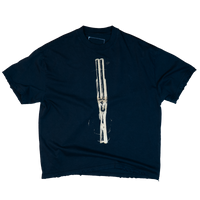
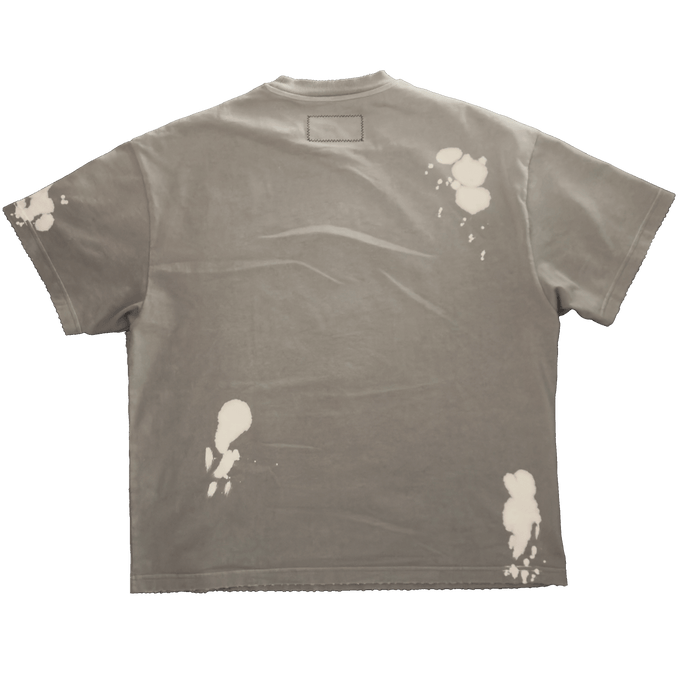
All the designs on our graphic tees are screen printed. At the moment we do almost all of the screen printing, bleach and paint splashes ourselves, by hand. Rich colour with sharp edges next to bleached patches and a vintage wash: that’s what a shirt looks like when it’s been worn since 1994. A fresh printout looks different.
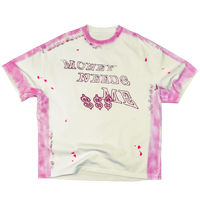
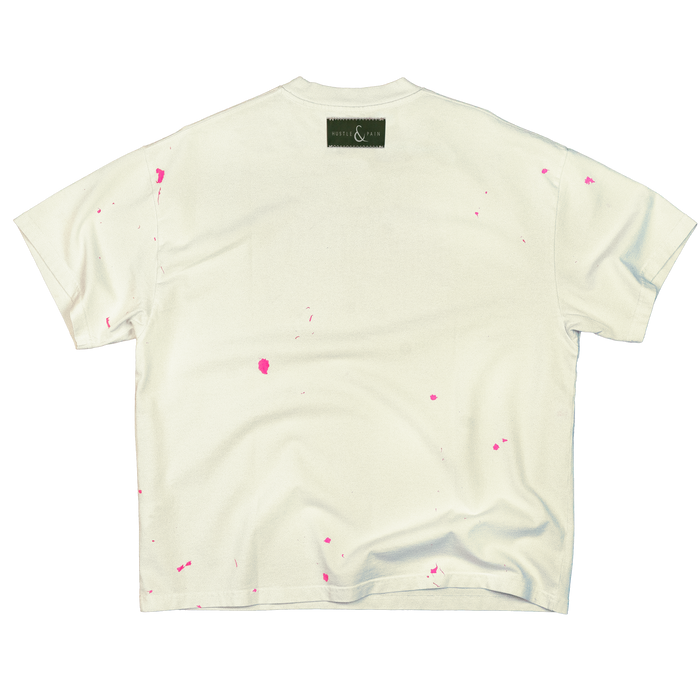
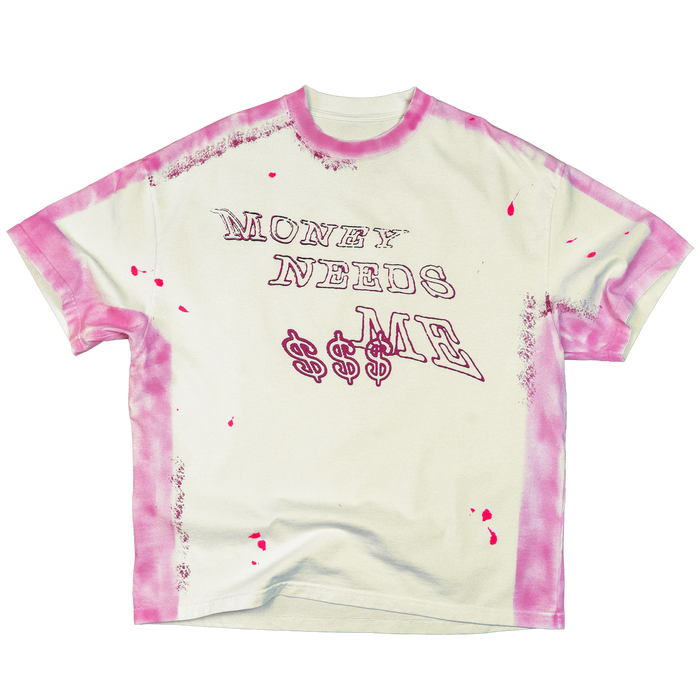
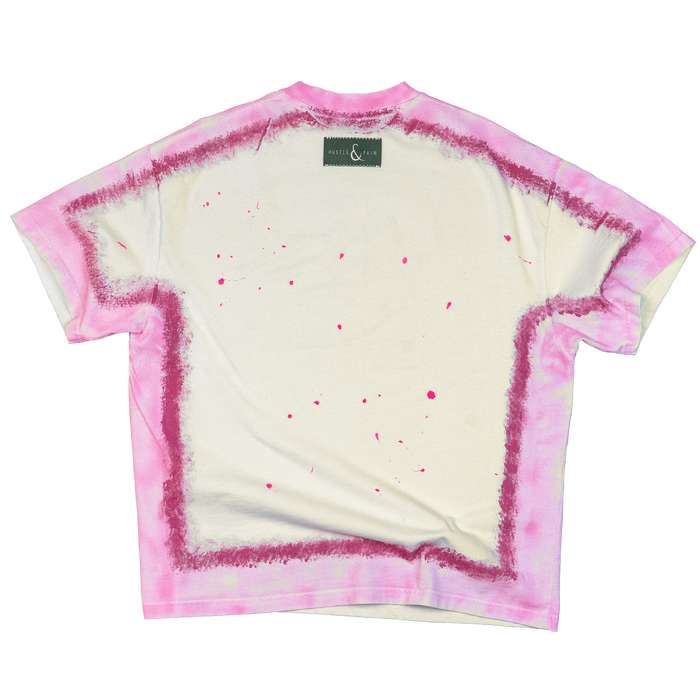
On LAW OF ATTRACTION, the lettering MONEY NEEDS ME with three dollar signs sits on Vintage White, plus hand-painted pink edges and colour splash (how both are made is explained in T-shirt finishing explained). PRICE OF FAME comes in Faded Concrete with a sun-faded look that lightens the fabric unevenly, plus bleach splashes and a rolled sleeve edge. And how far screen printing goes with a special ink is shown by DIRT MOUTH: a print with a metallic effect in a grillz look on Eggshell with Dirt Wash.
If somebody picks up one of these shirts in thirty years, they should be able to run a thumb over the print and feel the same edge as on the Nirvana shirt at the start.
Sources17
- Wikipedia: Siebdruck
- Wikipedia: Screen printing (English)
- Wikipedia: Plastisol (English)
- Lawson Screen & Digital Products: General Information about Screen Printing Plastisol Inks (English)
- McLogan: How to Properly Cure Plastisol Ink (English)
- Wikipedia: Sefar (English)
- Historisches Lexikon der Schweiz: Seide (Liliane Mottu-Weber, version of 2010)
- Wikipedia: Marilyn Diptych (English)
- Wikipedia: Stüssy (English)
- Wikipedia: Supreme (English)
- Wikipedia: Direct to garment printing (English)
- Printful: DTG-Druck (Direct-to-Garment), Vorteile, Kosten und Vergleich
- Wikipedia: Direct-to-film printing (English)
- Wikipedia: Dye-sublimation printing (English)
- Wikipedia: Shepard Fairey (English)
- Wikipedia: OBEY (clothing) (English)
From the article

Keep reading
-
 Style11 minWhat Is Gothic Streetwear?
-
 Style13 minWhat Goes with a Black T-Shirt?
-
 Style13 minWhat Goes with a Grey T-Shirt?