How to Wash a T-Shirt Properly?

Quick Answer
Sunday evening, 60 °C, then an hour in the tumble dryer on hot: there is no quicker way to turn an L into an M. Wash cotton at 30 to 40 °C, inside out and at no more than 1,000 rpm, then let it air-dry. White shirts without a print can also take 60 °C. Anything with a screenprint or a garment wash stays at 30 °C.
Washing a T-Shirt at a Glance
- Temperature: 30 to 40 °C, white basics without a print can also take 60 °C
- Our shirts: inside out, 30 °C, no tumble dryer
- Detergent: heavy-duty powder for whites, colour or delicates detergent for everything else
- Fabric softener: leave it out
- Spinning: 800 to 1,000 rpm
- Drying: in the open air, dark shirts in the shade, heavy shirts flat
- Ironing: from the inside, never over the print
- Yellow rims: treat early with ox-gall soap
- Musty smell: clean the door seal, run the machine at 60 °C once a month
- New shirts: wash before the first wear, the first few times with similar colours
Quick Questions
What temperature do you wash cotton T-shirts at?
At 30 to 40 °C. According to the Umweltbundesamt (German Environment Agency), normally soiled coloureds usually come clean at just 20 to 30 °C. White shirts without a print can go up to 60 °C if the label allows it. Shirts with a screenprint or a garment wash stay at 30 °C.
Do you need to wash new T-shirts before wearing them?
Yes, and the German federal health portal recommends it too, because washing rinses out residues of chemicals left over from production. Washed and dyed shirts only go in the machine with similar colours for the first few times, because they can still release colour.
How do you wash black T-shirts so they stay black?
Inside out, cold or at 30 °C, with a colour or black detergent without bleach. Dry them in the shade, because UV light bleaches colour.
Can a screenprinted T-shirt go in the tumble dryer?
Better not. Jersey shrinks more in the dryer, and under heat the print ink goes soft again. A heavy shirt only needs a few more hours in the open air.
In Detail: Temperature, Detergent, Drying, Ironing
The fibre itself is tough. Cotton takes so much heat that the care label has a symbol of its own for boil wash. What is sensitive is what sits on and in it: colour, print, wash, fit. That decides the temperature.
Washing Cotton: Which Temperature for Which Shirt?
- White basics without a print: 40 °C day to day, 60 °C if the label allows it and you want them properly white again.
- Coloured and grey shirts: 30 to 40 °C.
- Black shirts: cold or 30 °C. They still come clean: according to the Umweltbundesamt (German Environment Agency), 20 to 30 °C is usually enough for normally soiled coloureds.
- Shirts with screenprint, embroidery or a garment wash: 30 °C, inside out. That goes for every shirt in our shop.
A printed shirt at 60 °C? Possible. Just don't be surprised when the print ends up looking like a gig poster that spent a winter on a building-site fence. It comes clean at 30 °C as well, because the enzymes in today's detergents work especially at low and medium temperatures, breaking down protein, starch and fat. At high temperatures they stop working altogether.
Care Symbols: What the Label Tells You
The symbols on the label follow an international system, set out in the ISO 3758 standard and looked after in Europe by the association GINETEX. There are five symbols you need to know.
- Wash tub: The number is the maximum temperature. One bar underneath means a gentle cycle, two bars very gentle. A hand in the tub means hand wash.
- Triangle: bleaching. Empty triangle: chlorine and oxygen bleach allowed. With two diagonal lines: oxygen bleach only, so for example heavy-duty powder detergent. Crossed out: no bleach at all, so colour or delicates detergent only.
- Square with a circle: tumble dryer. One dot means reduced temperature, two dots normal, crossed out means never.
- Iron: One dot up to 120 °C, two up to 160 °C, three up to 210 °C, as set out in the overview from the industry association IKW of September 2025.
- Circle: professional cleaning. For a T-shirt you never need it.
The number in the tub is a ceiling, and a gentler treatment is always allowed. Max it out every time on a shirt with a print and you pay with colour.
How to Wash a T-Shirt, Step by Step
- Sort. Whites only with whites, darks with darks. A red shirt has no business in the white load.
- Turn inside out. That way fabric rubs on fabric in the drum, and not the print on the rivet of the jeans next to it. The US screen-printing supplier Lawson advises the same. Close any zips beforehand.
- Drum only half full. For the easy-care programme, the IKW works on about half the maximum load, for delicates a quarter.
- Pick a programme. Easy care or delicates at 30 °C for anything printed, the cotton programme for white basics.
- Turn the spin down. 800 to 1,000 rpm is enough. More presses creases into the fabric that you then have to iron out.
- Out straight away. Shake it out, pull it lengthways at the hem and widthways at the sides. Wet laundry that sits in the drum for hours soon smells musty.
Which Detergent for Cotton?
This is where many people go wrong. Liquid detergent contains no bleach, writes the Verbraucherzentrale (German consumer advice service). The reason is chemistry: dissolved bleach would make the enzymes in the detergent ineffective. For coloureds and blacks that is good. White shirts are left without exactly the bleach that, according to the Verbraucherzentrale, loosens stubborn dirt on white textiles.
Bleach is found in heavy-duty detergent in powder form, today mostly as sodium percarbonate, plus optical brighteners that make white look brighter. The principle is over a hundred years old: on 6 June 1907, Henkel advertised Persil for the first time in the Düsseldorfer Stadtanzeiger. The name stands for perborate and silicate. Perborate was the bleach.
- White without a print: heavy-duty detergent, powder.
- Coloured, black, printed or washed: colour or delicates detergent. Colour detergents contain neither bleach nor brighteners, and according to the Verbraucherzentrale, bleach fades colours as well as stains.
- Fabric softener: leave it out. The Umweltbundesamt advises against it altogether, and softener can make fabric water-repellent, so a softened shirt absorbs less moisture.
Dose by water hardness. With soft water, the Umweltbundesamt says the lowest amount on the pack is enough. More detergent doesn't wash cleaner, it just costs more.
Washing White T-Shirts So They Stay White
White shirts die slowly. First a grey haze at the collar, and at some point the whole shirt is a shade darker than the new one next to it. Two things speed that up: one coloured item too many in the drum and a detergent without bleach.
White stays white with heavy-duty powder detergent, 40 °C day to day and 60 °C every few washes if the label plays along. According to the Umweltbundesamt, white laundry usually comes clean at 40 °C already. Then out into the sun, because UV light bleaches laundry. People used to lay white laundry out wet on the grass for this, known as lawn bleaching. With coloured and black things, the sun does exactly the job you don't want.
The exception: white shirts with a print or a wash. ANTAGONIST is Vintage White, so deliberately not snow white, with pink lettering and pink paint splatters. Bleach and 60 °C would strip off exactly what you bought it for. Shirts like this get colour detergent at 30 °C, turned inside out. You'll find all the light shirts in the shop in the white T-shirts collection.
Yellow Stains on White T-Shirts: Where They Come From and What Helps
The yellow rims under the armpits rarely come from sweat alone. According to Öko-Test (a German consumer magazine), sweat, the active ingredients in deodorant and detergent residue usually combine badly, especially with deodorants that contain aluminium salts. Often the stains then no longer come out in the machine either. Pick one of the three home remedies, then wash the shirt as in step 4.
- Ox-gall soap: dampen the spot with warm water, rub the soap in, leave it for 30 minutes, repeat once.
- Vinegar overnight: 100 millilitres of vinegar essence in 500 millilitres of water, soak the shirt in it overnight.
- Citric acid overnight: three to four tablespoons to a litre of hot water, soak overnight.
- Then wash: heavy-duty detergent, 40 or 60 °C according to the label. Only dry the shirt once the stain is gone.
Vinegar and citric acid bleach, which is why Öko-Test recommends them only for light or white clothing. On shirts with a print, leave them out altogether.
Prevention is easier. Let the deodorant dry completely before the shirt goes over it, or use one without aluminium. Öko-Test advises both.
Does Cotton Shrink in the Wash?
Yes, a little. During spinning and knitting, the yarn is under tension. In water those tensions release, and the fabric pulls back into the shape it actually wants to have. Loosely knitted fabrics shrink more than dense ones.
The tumble dryer adds to it. Knitted fabric in particular tends to shrink in a drum dryer, even more when it is over-dried, and jersey is knitted fabric. Suddenly the hem ends above your belt. Good manufacturers work against this by pre-shrinking the fabric mechanically before it is cut. Our shirts with a garment wash are washed one by one after sewing, so they have already done part of their shrinking. The dryer does the rest, if you let it.
Rescuing a Shrunken T-Shirt
A home remedy is doing the rounds online: soak the shirt for half an hour in lukewarm water with a splash of hair conditioner, press it out gently, carefully pull it lengthways and widthways, and let it dry flat. We haven't found any research on it. Either way, an M won't turn into an L like this, and the attempt costs no more than half an hour.
Drying a T-Shirt: Why the Tumble Dryer Is Off Limits
One look at the lint filter is enough. The grey felt in there used to be your T-shirt. In the dryer, fibre ends break off, the cotton shrinks, and the heat attacks the screenprint. With us, that means no exceptions: no tumble dryer.
In the open air, a shirt dries best on a wide hanger or folded in the middle over the bar of the drying rack. Clothes pegs on the shoulders leave bumps that often stay until the next wash. Black and coloured shirts go in the shade, because UV light bleaches colour.
Heavyweight Shirts at 300 GSM
A shirt at 300 grams per square metre almost stands up on its own when dry. Wet, it hangs like a towel. On a narrow hanger its own weight pulls the shoulders long and the collar down. Lay heavy shirts flat on the drying rack and turn them over after a few hours. They take longer than a thin basic, so don't put them in a cold cellar, or they will smell musty before they are dry. What the GSM number means exactly is explained in the GSM guide, and the heavy shirts in the shop are in the Heavyweight T-Shirts collection.
Why Do T-Shirts Twist After Washing?
The side seam wanders to the front, the hem hangs crooked, the whole shirt looks as if it has turned around itself. And it has. In the textile industry this is called spirality, and there is a test standard of its own for it, ISO 16322.
Behind it is the construction. Jersey is made on circular knitting machines as a tube, and even then the rows of stitches don't run quite vertically, which the standard itself states. If the fabric isn't aligned exactly along the stitches when it is cut, the crooked seam is already built in. In the wash the tensions in the fabric release, and the shirt shows how it was cut.
You can't wash it out. Pulling it into shape while damp and ironing help for the moment. A shirt that twists around your hips after the first wash had the flaw before you bought it. That is not your fault.
Stretched T-Shirt Collar: How to Fix It and Prevent It
A wavy collar turns a good shirt into a sleep shirt in seconds. It stretches out when you pull the shirt over your head by the front of the neck, when a hanger is pushed through the neck opening, or when a wet shirt hangs from the shoulders and the water drags everything down.
To rescue it, dampen the collar, push the rib trim together with your fingers and iron over it bit by bit with plenty of steam. Then leave it lying flat until it is dry. On a properly stretched collar, this holds until the next wash.
- Put the hanger in from below through the hem, never through the collar.
- When taking the shirt off, grab it at the back of the hem instead of at the front of the neck.
- Dry wet shirts flat or folded in the middle over the line.
When buying, it's worth feeling the neck. A dense, firm rib trim and a tape sewn over the neck seam on the inside last much longer than a thin edge.
Why Do T-Shirts Smell After Washing?
Freshly washed and still musty: then the problem is often in the machine. Researchers at Furtwangen University, led by Prof. Markus Egert, examined samples from 13 household washing machines. The bacterium Moraxella osloensis, which according to Öko-Test is chiefly responsible for the smell, turned up in nine of 13 door seals. It sits in the damp rubber and, according to Egert, copes very well there with the changing conditions.
- Wash regularly at 60 °C or more, with a powder detergent that contains bleach, which is what Egert advises. The Umweltbundesamt recommends a 60 °C cycle once a month.
- Wipe out the door seal, then leave the door and the detergent drawer open so they dry out.
- Hang laundry up straight away and dry it in a ventilated room.
Boiling a printed shirt at 60 °C, on the other hand, does little if the smell is coming from the door seal.
Ironing a T-Shirt: Over the Print Too?
Never directly. Most screenprints are made of plastisol, PVC particles in a plasticiser. Plastisol sets with heat and softens again under heat, which is why Lawson advises never ironing the printed part.
- Turn the shirt inside out and iron it slightly damp, then less heat is enough.
- Two dots at most, so medium heat up to 160 °C, even if the label allows three.
- If the iron has to go over the print, put baking paper in between.
- Iron embroidery, like the back motif on YOKO ONO, from the reverse on a folded towel, so the iron doesn't flatten the stitches.
- Don't let prints with a metallic effect, like on DIRT MOUTH, come into contact with heat at all.
With heavy shirts the question often doesn't come up. If you pull them smooth while wet and dry them flat, you mostly don't need an iron, and for the rest a garment steamer that never touches the print is enough.
Vintage Wash and Print: What Is Different with Washed Shirts
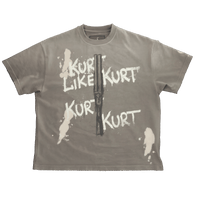
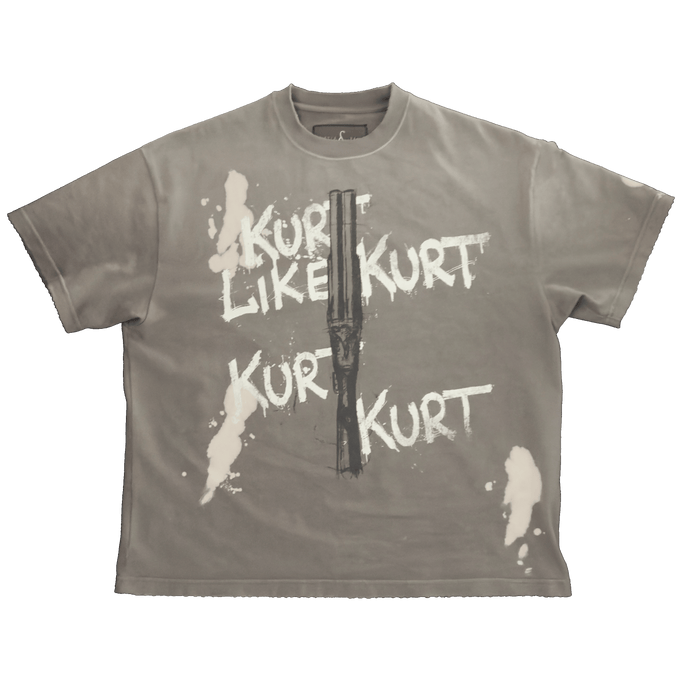
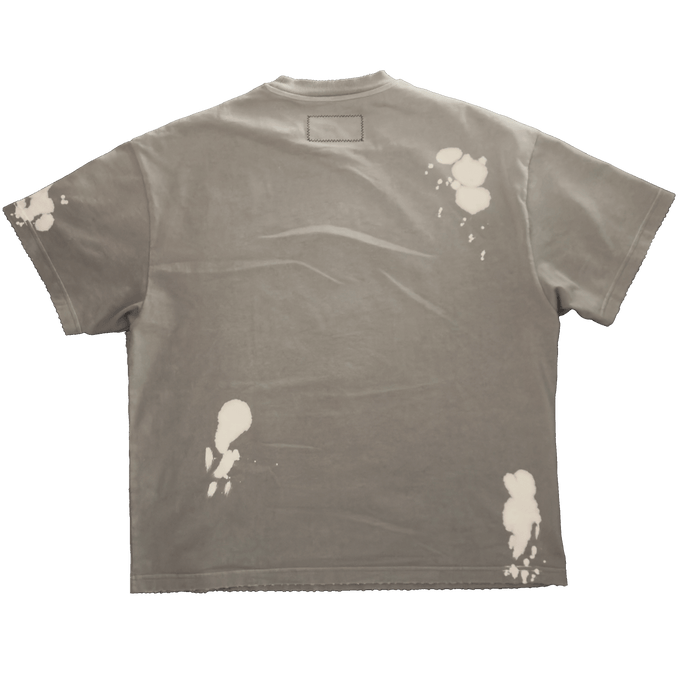
A shirt like LIKE KURT looks as if it has spent three summers on a washing line in Seattle: grey, bleached by the sun, with pale bleach marks and frayed hems. That look is created in the after-treatment, and it keeps working in your machine. That is intended, as long as you don't speed it up.
- The first washes separately: Washed and dyed shirts can still release colour at first. If the label says “wash separately”, according to gesund.bund.de that points to colour that bleeds. Two or three washes only with similar colours.
- Pigment dye fades slowly: With pigment dyeing, the colour sticks to the fabric via a binder instead of soaking into the fibre. Every wash takes a little of it with it. At 30 °C it happens slowly.
- Bleach marks stay as they are: They don't spread as long as no new bleach touches the shirt. So no heavy-duty detergent.
- Distressed hems keep fraying: In a laundry bag the open hems stay the way they were meant to be for longer. Cut off loose threads, don't pull them.
How washes like these are made is explained in the article on vintage wash. Our rule for every shirt in the shop fits on a note: inside out, 30 °C, no tumble dryer.
How Often Should You Wash T-Shirts?
Less often than most people do, because every wash costs fibre and colour. A shirt you have worn for one evening hangs overnight at an open window and is fresh again in the morning. Directly on the skin on an ordinary day, washing after one or two wears is enough. After the gym or an August day on a packed S-Bahn (city train): straight away. You treat individual stains with a damp cloth and a little ox-gall soap, without the whole shirt having to go into the drum.
Sources19
- Umweltbundesamt: Wäsche waschen und Waschmittel
- Verbraucherzentrale: Wäsche waschen, bewährte Waschmittel und überflüssige Produkte (as of 22.05.2026)
- IKW, Industrieverband Körperpflege- und Waschmittel: Textilpflegesymbole nach GINETEX (as of September 2025, PDF)
- Wikipedia: Textilpflegesymbol
- Wikipedia: Waschmittel
- Wikipedia: Persil
- Wikipedia: Weichspüler
- Wikipedia: Bleichen, section Rasenbleiche
- Wikipedia: Wäschetrockner
- Wikipedia: Krumpfen
- Wikipedia: Shrinkage (fabric) (English)
- Öko-Test: Woher kommen gelbe Flecken auf weißer Wäsche? (17.08.2026)
- Öko-Test: Neue Waschmaschinen-Studie, heißes Waschen könnte zu mehr Keimen führen (25.01.2020)
- Bild der Wissenschaft: Was lebt in der Waschmaschine? (30.05.2021)
- AFNOR: ISO 16322-2:2021, Spiralität nach dem Waschen (April 2021, English)
- Wikipedia: Plastisol (English)
- Lawson Screen & Digital Products: General Information about Screen Printing Plastisol Inks (English)
- gesund.bund.de: Chemikalien in Kleidung (as of 03.02.2026)
- Fibre2Fashion: Production Process for Pigment Dyed Garment (February 2011, English)
From the article
Keep reading
-
 Style11 minWhat Is Gothic Streetwear?
-
 Style13 minWhat Goes with a Black T-Shirt?
-
 Style13 minWhat Goes with a Grey T-Shirt?