Men's T-Shirt Size Guide: What Size Am I?

Quick answer
Two shirts, both with an M in the neck: one measures 50 centimetres flat from armpit to armpit, the other 60, because it is cut oversized. So only a tape measure tells you which T-shirt size you are. Your chest circumference gives you the letter size (in German charts usually M at 94 to 101 cm, L at 102 to 109 cm), and the flat width of your best-fitting shirt shows which size suits you in a particular model.
The right size at a glance
- Chest circumference: horizontal at the widest point, tape snug, one finger of room
- Letter: M usually 94 to 101 cm, L 102 to 109 cm chest circumference
- Rule of thumb: German clothing size is roughly half the chest circumference
- Favourite shirt: lay it flat, measure the width from side seam to side seam
- Flat measurement: times two gives the circumference of the shirt
- US and UK: German clothing size minus 10 gives the jacket size there
- Oversized and boxy: your usual size
- Slim fit: if in doubt, the bigger one
- Tumble dryer: skip it, otherwise the measurements soon stop being right
Quick questions
What T-shirt size am I at 180 cm?
Height alone doesn't tell you. Two people who are both 1.80 m tall can wear very different sizes, what counts is chest circumference. How tall our model is and which size they wear is shown on the product page under “Fitting Guide”.
What does the tolerance in a size chart mean?
It tells you how far a single shirt may deviate from the number in the chart, either way. With us, it is listed right below the chart of each shirt. Cotton jersey moves in the wash, and most of our shirts are also finished by hand after sewing, which is why two shirts in M are never identical to the millimetre.
Do the shirts fit women too?
Yes, all our shirts are unisex and follow the same chart. The safest way is to measure a shirt that fits you well, flat, and compare the width, because women's sizes are counted differently from men's sizes.
What do I do if I'm between two sizes?
That depends on the cut. With oversized and boxy, take the smaller one if you like it calmer. With slim fit, take the bigger one, because tight cotton hardly gives.
In detail: measuring, reading charts, choosing a cut
The letter is a convention, and every brand interprets it a little differently. Ten minutes with a tape measure save you the return label.
What T-shirt size am I? Two measurements are enough
For the right size you need exactly two numbers, and only one of them has anything to do with your body.
The first is your chest circumference. With it you find your letter size in a general chart, and that is enough for classically cut shirts.
The second is the width of a shirt that fits you really well, measured flat on the table. You hold that number up against the measurement chart of the shirt you want to buy. That works with every cut, even oversized, where the letter says hardly anything about the width.
If you only have time for one measurement, take the second.
How to measure your chest: the right way
You need a soft tape measure from the sewing box and ideally someone to check the back. Hardly anyone keeps the tape straight round their own back.
- Measure in a thin shirt or without one, because a hoodie under the tape quickly adds several centimetres.
- Place the tape horizontally around the widest part of your chest, directly under the armpits, at the front roughly level with the nipples and at the back across the shoulder blades. Check in the mirror that it doesn't sag at the back, because a slanted tape always reads too much.
- Let your arms hang loose and breathe normally, because a puffed-up chest measures a torso you don't have in everyday life.
- Pull the tape snug, but not tight. One finger should still fit underneath, because a tight tape digs into the tissue and makes you a size smaller.
- Finally, measure your stomach too. If it is wider than your chest, the bigger value counts, because the shirt has to hang there without pulling as well.
As a rule of thumb, the German men's clothing size (numbers like 48 or 50) is roughly half the chest circumference. Wikipedia is more exact: highest chest circumference minus one, divided by two. At 100 centimetres you land on 50, and in most charts that is M.
Men's T-shirt size chart: typical values in Germany
Most German retailers match chest circumference and letters almost identically. The values below are as they appear in the men's chart from Otto (a German online retailer), and Tchibo assigns S to 3XL the same way. They are typical guide values for your body, not measurements of our shirts.
- XS: chest 78 to 85 cm, German size 40/42
- S: chest 86 to 93 cm, German size 44/46
- M: chest 94 to 101 cm, German size 48/50
- L: chest 102 to 109 cm, German size 52/54
- XL: chest 110 to 117 cm, German size 56/58
- XXL: chest 118 to 125 cm, German size 60/62
- 3XL: chest 126 to 133 cm, German size 64/66
The European standard EN 13402 sets the limits almost identically, with M running from 94 to 102 centimetres. Tables like these rest on large body-measurement surveys. For men, the last survey before 2007 ran in the seventies. From August 2007, the Hohenstein Institutes in Bönnigheim then scanned 13,362 people between 6 and 87 years old with a laser full-body scanner for the SizeGERMANY project, commissioned by 80 companies, mostly from the fashion industry. The results came in February 2009 and are not public, available only to the clients (Wikipedia). In the end, every brand cuts to its own numbers.
How far apart this can go is shown by the rock and merch retailer Impericon: there, M already starts at 90 centimetres of chest circumference. At 92 centimetres you are an S at Otto and an M at Impericon, and both shops are right.
EU, US and UK: what the letters mean in other countries
S, M and L appear on labels worldwide, the numbers behind them don't. For jackets and blazers, American and British sizes are counted differently, and the rule of thumb for converting is: German clothing size minus 10. 48 becomes 38, 50 becomes 40, as the comparison chart on Wikipedia shows.
- XS: DE 40/42, US/UK 30/32
- S: DE 44/46, US/UK 34/36
- M: DE 48/50, US/UK 38/40
- L: DE 52/54, US/UK 42/44
- XL: DE 56/58, US/UK 46/48
- XXL: DE 60/62, US/UK 50/52
With shirts from the US, it is still worth a second look at the shirt measurements rather than the letter. If a shop's chart is only in inches, convert quickly: one inch is 2.54 centimetres.
How to measure a T-shirt: width, length, shoulder, sleeve
For the second measurement, take your best-fitting shirt out of the wardrobe, ideally one in the same cut as the one you want to buy: compare oversized with oversized, slim with slim. Lay it smooth on the table and don't pull anywhere, because jersey gives and every number can be stretched by a centimetre or two.
- Width: horizontally from side seam to side seam, just below the armpits. Some charts measure directly under the sleeve join, while Baur (another German retailer) advises a hand's breadth below. That is why two charts for similar shirts rarely show the same number, and you are best off measuring the way the chart in front of you describes.
- Length: from the highest point of the shoulder right next to the collar, straight down to the hem edge.
- Shoulder: across the back from shoulder seam to shoulder seam. Some charts measure only one side, from the collar to the seam. Then the number is about half as big, and the sketch next to the chart tells you which variant is meant.
- Sleeve: from the shoulder seam along the top edge to the end of the sleeve.
Drop shoulder: why shoulder and sleeve measurements mislead on oversized shirts
On oversized shirts, the shoulder seam sits a few centimetres lower on purpose, on the upper arm. That makes the shoulder measurement bigger and the sleeve, measured from the seam, shorter, even though the fabric reaches just as far down the arm. With cuts like this, compare shoulder and sleeve together: shoulder width plus twice the sleeve gives the span from sleeve end to sleeve end, and you can compare that with any other shirt.
How to read a size chart with flat measurements
You have a chest circumference of 100 centimetres, and a shop's chart says 60 for M. Many people think: far too small. It isn't. The 60 is only the width across the front, measured flat. Around the body the shirt is twice as wide, so 120 centimetres.
- Check the header of the chart to see whether body measurements or shirt measurements are meant. If it says “measured flat”, “width” or “chest width”, it is about the shirt.
- Lay your favourite shirt next to it and find the size whose width comes closest to your measurement.
- Then check the length. If your shirt matches M in width and L in length, go with whatever bothers you more day to day.
- Look at the tolerance. It says how far a single shirt may deviate from the number in the chart.
The gap between shirt circumference and chest circumference is the room the cut gives you. An M that is 50 centimetres wide laid flat is 100 all the way round. With a 95 centimetre chest, that leaves you only 5 centimetres of room. With an oversized shirt, it is often more than 20. That is the oversized cut in a single number.
Where to find our measurements
Every shirt has its own chart. You find it on the product page under “Fitting Guide”, measured flat. The letters show where to measure:

A chest, B length, C sleeve, D sleeve opening, E shoulder.
All our shirts are unisex, for men and women. With our wide models, the width is already built in, so you don't need to order bigger to wear it wide. Boxy is a little shorter, slim fit is tighter, YOKO ONO is extra long. Under “Fitting Guide” you can also see how tall our model is and which size they wear. If you are about as tall, the photos show you pretty well how the shirt will fall on you.
Oversized, boxy, slim fit: order bigger or smaller?
Oversized: your usual size
An oversized shirt is cut to hang wide in your usual size already. So take the size you normally wear. One size up works if you want it more extreme, but the shirt also gets longer, and the shoulder seam wanders further down the arm. If the sleeve reaches past your elbow, the shirt is too big. If you are between two sizes and like it calmer, take the smaller one.
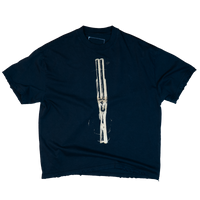
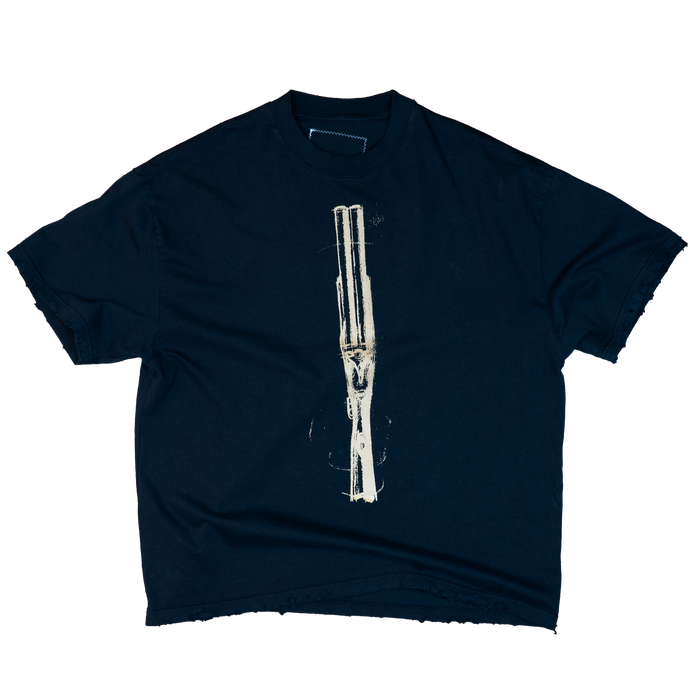
SHOTTIE shows how that looks in black: 300 GSM, heavy enough that the width holds its shape instead of hanging off you. What makes a good oversized fit is covered in our guide to the oversized fit. All our shirts in this cut are under Oversized T-Shirts.
Boxy: look at the length first
Boxy means wide and a little shorter. If you order bigger here, you mainly get more length, and then the boxy proportion you wanted the shirt for is gone. Stay with your size. If you are very tall, look at the length in the chart first and the width only after that. On boxy shirts like FUGITIVE or PRICE OF FAME, the slightly shorter hem is intended. On both, you open the chart right on the product page with the “Size chart” button.
Slim fit: if in doubt, the bigger one
A slim fit shirt sits close to the body, and pure cotton without elastane hardly gives. If you are between two sizes, take the bigger one here, because a slim shirt that is too tight shows straight away: if diagonal creases run from the armpits across the chest, it is pulling.
Relaxed, like ENERGY, sits in between, looser than regular and less wide than oversized. Your usual size fits here. How the three main cuts differ in detail is shown in our comparison Boxy vs. Oversized vs. Slim Fit.
Common T-shirt size mistakes
- Comparing a body measurement with a flat measurement. 100 centimetres of chest against 60 centimetres of width sounds too tight, but the shirt is 120 all the way round: plenty of room. Double first, then compare.
- Trusting the letter. An M is not the same size everywhere, every brand and every shirt has its own measurements. Compare numbers, forget the letters.
- Using a bagged-out shirt as your template. A shirt that has widened after many washes distorts every measurement. Take one that still holds its shape.
- Buying a regular shirt two sizes up for the oversized look. It mainly gets long, and the shoulder seam slides towards the elbow. An oversized cut in your size fits better.
- Forgetting the length. If you are tall, you notice it at the hem first, because the length usually grows only a little from one size to the next.
- Putting the shirt in the tumble dryer. Heat and drum make cotton shrink, and suddenly the right size feels too small. Wash our shirts inside out at 30 °C and let them air-dry, and the measurements from the chart stay the measurements of your shirt.
And the two shirts from the start? Both have an M in the neck, and only one of them fits you. You will know which after ten minutes with a tape measure, long before the courier rings the bell.
Sources7
- OTTO: Größentabellen für Herren (in German)
- Tchibo: Größentabellen für Herrenkleidung (in German)
- Wikipedia: Konfektionsgröße (in German, with EN 13402 and SizeGERMANY)
- Wikipedia: EN 13402 (in German, redirects to the article Konfektionsgröße)
- Wikipedia: Clothing sizes
- Impericon: Größen (in German, with measurements of the merch blanks)
- BAUR Magazin: T-Shirt Größentabelle für Damen und Herren (in German)
From the article
Keep reading
-
 Style11 minWhat Is Gothic Streetwear?
-
 Style13 minWhat Goes with a Black T-Shirt?
-
 Style13 minWhat Goes with a Grey T-Shirt?