What Does Oversized Mean?

Quick answer
Literally, oversized means bigger than the normal size. On a T-shirt it means a cut that is built wider from the start: the shoulder seam sits below the shoulder bone, the body is broader, and the sleeves end just above the elbow. It has nothing to do with large clothing sizes. You can get an oversized T-shirt in XS too.
Quick questions
What does oversized mean in fashion?
Literally, larger than normal. In fashion it means a deliberately wide cut, not a large clothing size.
Should you size up in an oversized T-shirt?
Usually not, because the room is already in the cut. One size up is mainly worth it if you have broad shoulders.
Where should the shoulder seam sit on an oversized T-shirt?
A few centimetres below the shoulder bone, already on the upper arm. If it sits halfway down to the elbow, the shirt is too big.
How long should an oversized T-shirt be?
It covers the waistband and ends between the hip bone and halfway down your backside.
Is oversized the same as boxy?
No. Oversized is wide and normal length, boxy is broad and shorter, almost box-shaped. Our comparison of the cuts shows how differently the two look on the body.
Oversized at a glance
- Shoulder seam: a few centimetres below the bone, on the upper arm
- Length: over the waistband, down to somewhere between hip bone and halfway down your backside
- Sleeves: end between the middle of the upper arm and the elbow
- Collar: sits close to the neck, everything below it can be loose
- Size: your normal one, one size up if you have broad shoulders
- Women: with us, one size smaller than in womenswear
- Fabric: heavy enough to hold its own shape, ours is 300 GSM
- Measuring: laid flat from armpit seam to armpit seam, then compare with the chart under “Fitting Guide”
- Tumble dryer: skip it, or the shirt shrinks in length
In detail: cut, origins, sizing
The Duden (the standard German dictionary) defines oversized as “larger than actually necessary”. For a T-shirt, that’s only half the story. Buy a normal shirt two sizes up and you get a shirt that is too big, and you can tell it apart from an oversized cut at two metres. It’s in the shoulder.
What does oversized mean? The word, and what it means on a T-shirt
The word is simply over plus size. English has both forms, oversize and oversized, with the same meaning. So an oversize T-shirt and an oversized T-shirt are the same piece, and the spelling is down to taste.
Taken literally, oversized just means bigger than normal. That still misleads, because the term has nothing to do with plus sizes. Oversized describes how a piece is cut, not who it’s for. A shirt in XS can be oversized, and one in XXL can fit tight.
With an oversized T-shirt, the room is already in the pattern. Shoulder, chest and sleeves are drafted wider than on a regular fit, while collar and length stay in proportion. That creates the typical silhouette: softly dropping shoulders and an upper body the fabric never clings to.
Where did the oversized trend come from? From Yohji Yamamoto to Essentials
Paris, 1981: lots of black, lots of fabric
In the eighties, fashion often meant shoulder pads and power dressing. Then Yohji Yamamoto showed in Paris for the first time in 1981, almost entirely in black, with wide, often oversized cuts and fabric that fell over the body instead of tracing it. Black is modest and arrogant at the same time, Yamamoto once said. The same goes for his silhouettes.
A few years later the Belgian designer Martin Margiela, who opened his own house in Paris in 1988, made the oversized silhouette one of his signatures. That was catwalk fashion: expensive, and a long way from the street.
Hip-hop and skate: your big brother’s shirt
In the nineties, baggy became the uniform on the street. Kris Kross, two kids from Atlanta, wore their baggy clothes back to front and turned it into a trend. Jodeci’s loose clothes looked like hand-me-downs from an older, bigger relative, and that was the point: dressing like that made you look tougher. Larry Clark’s film “Kids” from 1995 shows how skaters in New York dressed back then.
Old photos also show where all that room came from. The shoulder seam hangs halfway down the upper arm, and the sleeves reach past the elbow. People simply bought bigger. That is a look of its own, and today’s oversized cut sits differently.
Vetements and Balenciaga: oversize as luxury
In 2014 the Georgian brothers Demna and Guram Gvasalia founded Vetements. The brand made its name with oversized proportions, sleeves that fell far over the hands, and a yellow T-shirt with the logo of the parcel service DHL for the spring 2016 season, which sold out despite its high price. Balenciaga brought Demna in as creative director in 2015, and in 2025 he moved to Gucci. In the ten years in between, wide, loose cuts were part of his signature.
The heavy shirt: Fear of God Essentials and Represent
What people wear on the shopping streets between Hamburg and Munich today comes from somewhere else. Jerry Lorenzo first got noticed with Fear of God for his extra-long T-shirts, and in 2018 the cheaper sister line Essentials followed. Represent was founded in Manchester in 2011 by the brothers George and Mike Heaton. Both turned the XXL hip-hop shirt into a considered cut: dropped shoulder, broad body, a controlled length and fabric with real weight to it.
That is the cut we mean when we say oversized.
Oversized or just too big? Five places to check
Lay a normal shirt in M next to one in XXL from the same maker. The big one is bigger everywhere, including where it shouldn’t be. In an oversized cut, only the parts meant to grow get bigger.
- Shoulder: On a shirt that’s too big, the seam slides halfway down the upper arm by accident. On an oversized cut it sits a little below the bone on purpose, and the sleeve is matched to it.
- Collar: With every size, the neckline gets wider and deeper. An oversized T-shirt keeps a collar that sits close to the neck, and because the collar frames your face, a wide neckline shows at once that it is a normal shirt in a bigger size.
- Length: On standard cuts it grows too. An XXL then reaches mid-thigh, even though all you wanted was width.
- Sleeves: Too big means sleeves hanging past the elbow and fabric bunching in the crook of the arm.
- Fabric: A thin shirt in XXL collapses in on itself. Without weight, width just hangs limp and never becomes an oversized look.
Oversized is a cut of its own. Too big is a normal cut, just bigger.
How should an oversized T-shirt fit? The mirror check
Put the shirt on, stand side-on to the mirror and let your arms hang loose. Four spots tell you everything.
Shoulder: the seam sits on the upper arm
Feel for the bone on the outside of your shoulder. The seam should sit a few centimetres below it, already on the upper arm, so the shoulder drops softly. If it sits right on the bone, you’re basically wearing a normal shirt. If it hangs halfway between shoulder and elbow, it’s too big, because then the whole sleeve slides down with it.
Length: over the waistband, not down to the thigh
The hem loosely covers the waistband and ends somewhere between the hip bone and halfway down your backside. Any shorter and it heads towards boxy, and the width looks stronger. Down to mid-thigh, it becomes a long shirt and your legs look shorter. If you want to take off length, tuck the front loosely into your waistband (the front tuck), and nothing changes at the shoulder.
Sleeves: stop just short of the elbow
The sleeve ends between the middle of the upper arm and the elbow. Any longer and the fabric bunches in the crook of your arm as soon as you bend it. The sleeve opening can be wide, though. In heavy fabric it stands slightly away from the arm, and that’s part of the look.
Collar: close to the neck, room below
The collar sits against your neck without pressing. Below it, everything can be loose. A collar that already ripples in the shop won’t get any better in the wash.
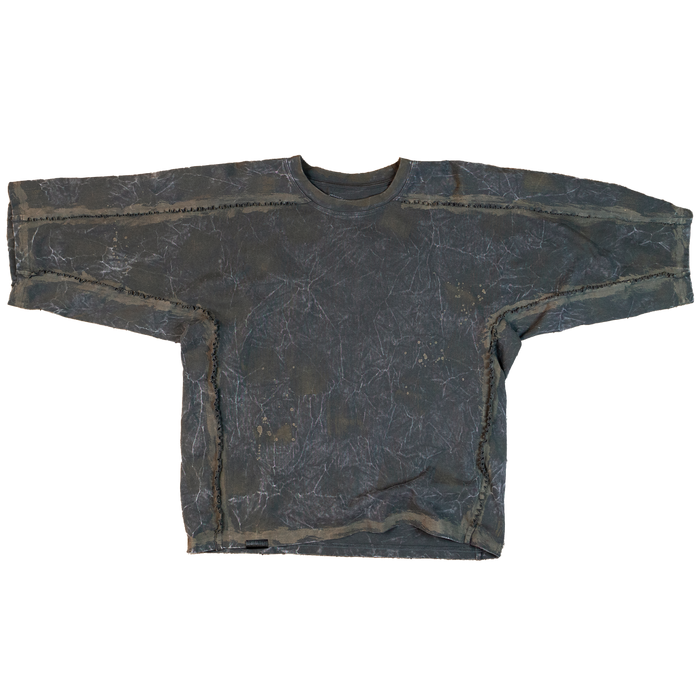
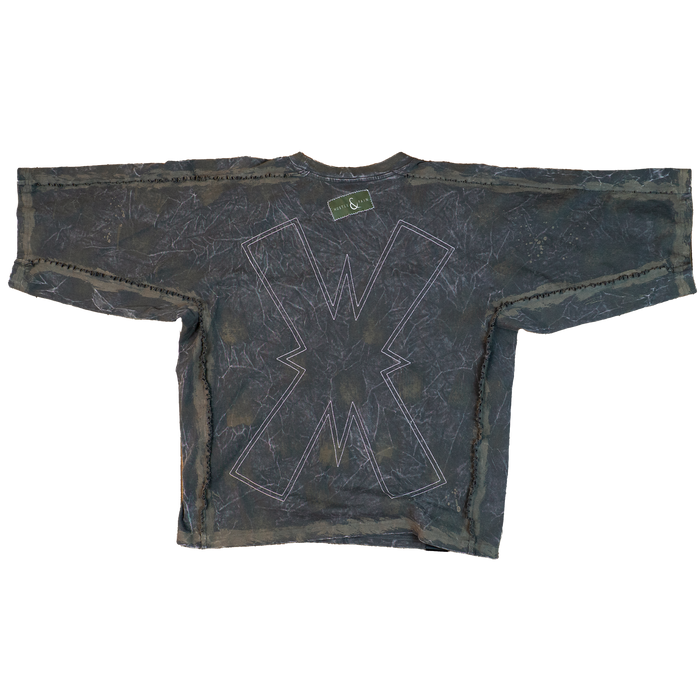
An exception to the shoulder rule is YOKO ONO. The shirt has a kimono cut with no shoulder seam: sleeves and body are cut from one piece. The room spreads across the whole upper body, and because the cut is extra long, the length is the main thing to check here.
Oversized T-shirt size: your normal size or one size up?
Take your normal size. The room is already in the cut, and if you add another size on top, you get the look of the nineties: seam halfway down the upper arm, sleeves past the elbow.
You can see what one size up gets you in the chart on the shirt’s product page under “Fitting Guide”. It also says how tall the model is and which size they wear.
Broad shoulders: when to size up
For men, the shoulder is usually the bottleneck. If you’re broad or train a lot, you’ll sometimes find that in your usual size the seam is back on the bone. Then one size up is right, because the cut only works with room at the shoulder. If you’re slim, stay with your size, even if you’re between sizes.
Unisex for women: how our sizes run
All our shirts are unisex, women and men wear the same sizes. Our smallest, XS, gives a woman with a slim upper body about as much room as our M gives a man with a broad chest. The effect is the same, just one or two sizes lower.
Our advice: with us, go one size smaller than you wear in womenswear, so XS instead of S and S instead of M. In the small sizes, length is more of an issue, so compare the length of XS in the shirt’s chart with a shirt from your wardrobe first. If you like the shirt deliberately long, stay with your usual size.
How to measure your favourite shirt
Your body measurements don’t help much here, because you want room and don’t know in advance how much. A shirt that already fits the way you like it is a better guide.

A chest, B length, C sleeve, D sleeve opening, E shoulder: the letters appear the same way in the chart on the product page.
- Lay it flat: shirt smooth on a table or the floor, front facing up, seams pulled straight, because a slanted hem can easily throw you off by two centimetres.
- A · Chest: straight across from armpit seam to armpit seam, just below the sleeves.
- B · Length: from the highest point of the shoulder next to the collar, straight down to the hem.
- Compare: put both numbers next to the shirt’s chart.
Every shirt has its own chart. You find it on the product page of our Oversized T-Shirts under “Fitting Guide”.
Width times two gives you the circumference. The room between body and shirt is what makes the fit. For comparison, measure a normal shirt from your wardrobe the same way: the difference from the chart is the oversized part, in black and white.
After sewing, most of our shirts are washed, bleached or distressed by hand, and cotton doesn’t react the same way on every piece. So a single shirt can differ slightly from the chart. If you land right in between, your taste decides: looser or more controlled.
300 GSM: why heavy fabric carries the oversized fit
GSM stands for grams per square metre. Our oversized T-shirts come in at 300 GSM, twice the 150 GSM of ART OF LIFE, our lightest shirt.
Light jersey follows gravity and the body. It hangs from the shoulders, settles against stomach and back and creases slightly every time you move. At 300 GSM the fabric stands away from the body, the shoulder keeps its edge, and the hem falls straight down instead of wrapping itself round the hips. The shirt has a shape of its own, and all you do is put it on. That’s why a thin shirt in XXL never becomes an oversized cut. How 150, 250 and 300 GSM feel is covered in our GSM guide.
To keep that shape, wash the shirt at 30 °C, because cotton shrinks in hot water. The real enemy is the tumble dryer: in there, cotton jersey usually shrinks in length first, and an oversized T-shirt that gets shorter ends up just looking wide.
Our oversized T-shirts: one weight, five faces
Our five oversized shirts are 100% cotton at 300 GSM, with the designs printed or embroidered and almost every piece finished by hand. You’ll find them all together under Oversized T-Shirts.
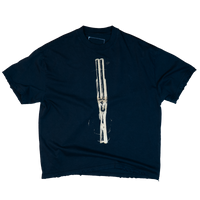
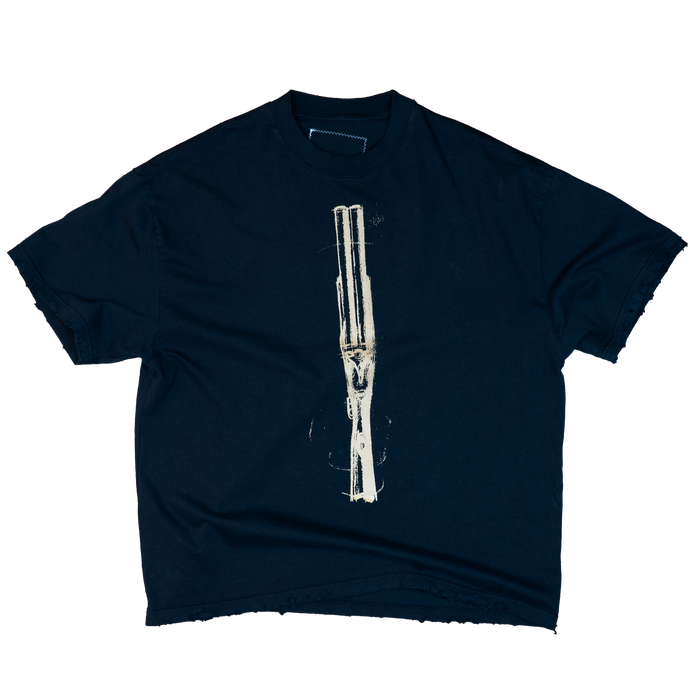
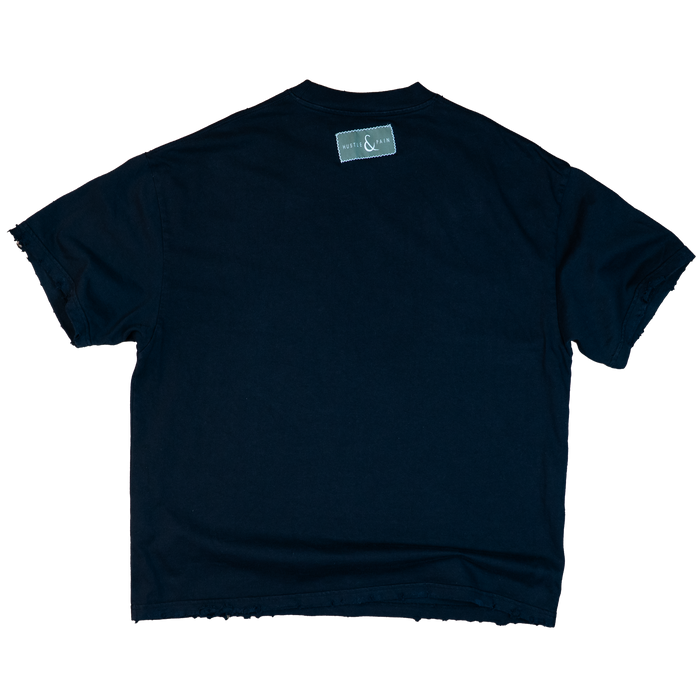
- SHOTTIE: black, distressed hem, screen print on the front, embroidered label. The plainest of the five, which makes it the best place to start.
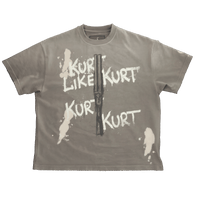
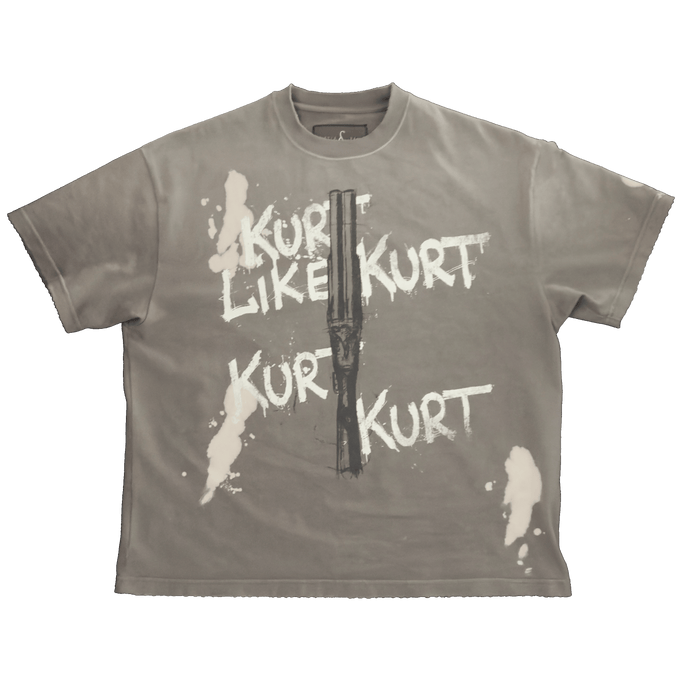
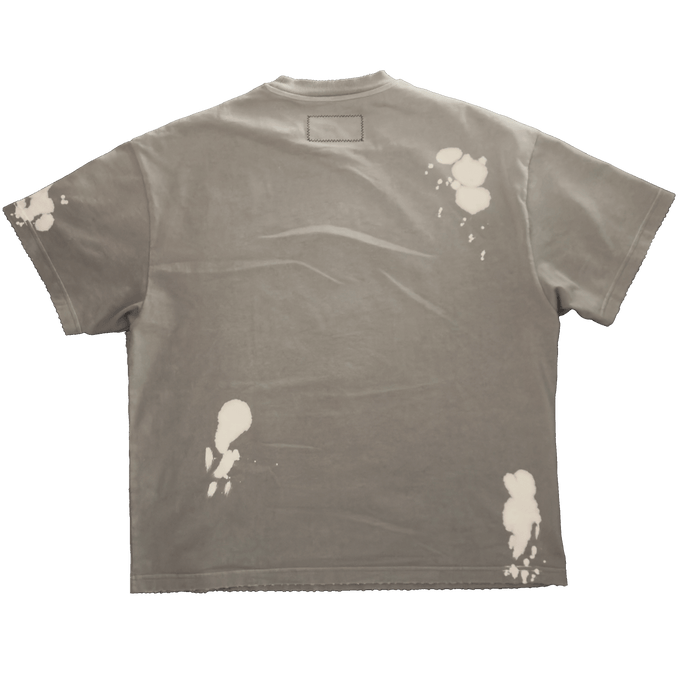
- LIKE KURT: grey with a sun-faded wash, bleached patches and roughed-up hems. On day one it looks as if it already has three summers behind it.
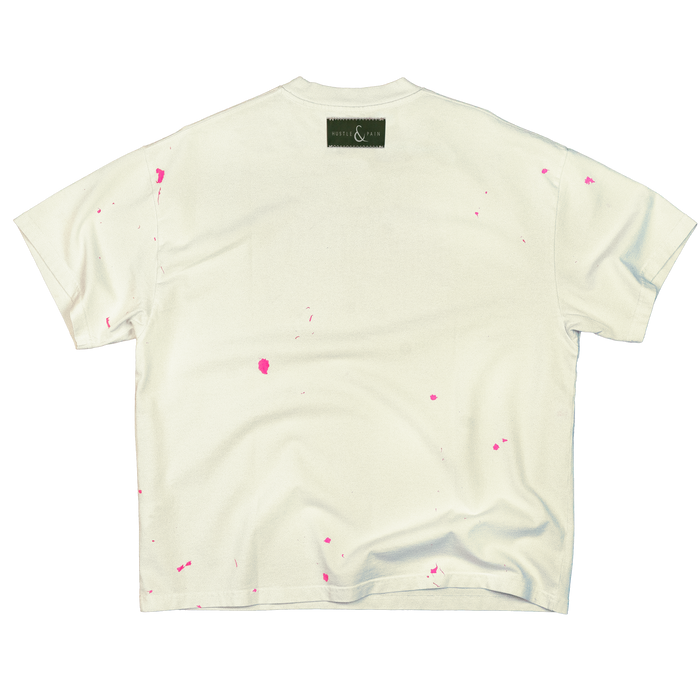
- ANTAGONIST: Vintage White, pink screen-printed lettering, pink paint splatters.
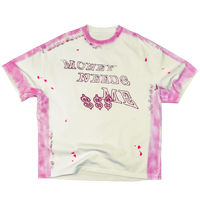
- LAW OF ATTRACTION: Vintage White, MONEY NEEDS ME in screen print, pink edges painted by hand.
- YOKO ONO: extra long, kimono cut with no shoulder seam, marble wash, contrast embroidery on the back.
If you want width but less length, boxy will suit you better. Our comparison Boxy vs. Oversized vs. Slim Fit shows the difference.
A real oversized shirt is wide, the seam sits on the upper arm, and the neckline still stays close to the neck. Buy a normal shirt two sizes up and the neckline gets wide too and hangs down.
Sources13
- Duden: oversized (German)
- Wiktionary: oversize (English)
- Wikipedia: 1980s in fashion (English)
- Wikipedia: Yohji Yamamoto (English)
- Wikipedia: Maison Margiela (English)
- Wikipedia: Martin Margiela (English)
- Wikipedia: Kris Kross (English)
- Wikipedia: Hip-hop fashion (English)
- Wikipedia: Kids, 1995 film (English)
- Wikipedia: Vetements (English)
- Wikipedia: Demna Gvasalia (English)
- Wikipedia: Jerry Lorenzo (English)
- Represent: Our Story (English)
From the article

Keep reading
-
 Style11 minWhat Is Gothic Streetwear?
-
 Style13 minWhat Goes with a Black T-Shirt?
-
 Style13 minWhat Goes with a Grey T-Shirt?