How to Fold a T-Shirt?

Quick answer
In the shop the stacks look as if they were drawn with a ruler, at home they tip over sideways after three days. You fold a T-shirt properly by laying it flat, front face down, folding both sides in to the middle together with the sleeves, and flipping the hem up to just under the collar. Then you turn the bundle over, and the chest with the print is on top.
Folding a T-shirt at a glance
- Before: only fold dry shirts, ideally straight off the line
- Classic: front face down, sides in to the middle together with the sleeves, hem up to under the collar
- KonMari: in halves or thirds, then upright into the drawer
- 2 seconds: three points on a line, arms crossed
- Folding board: every bundle the same size, the stack doesn't tip
- Suitcase: roll basics, keep print shirts and anything from 250 GSM flat
- Heavyweights: fold instead of hang, wider and with fewer layers
- Prints: fold lines beside the motif, never through it
Quick questions
What is the fastest way to fold a T-shirt?
With the 2-second trick: grab three points on a line, cross your arms, lift, put down. After a few practice rounds it really works, but it is too imprecise for neat stacks.
How do I fold T-shirts so they don't crease?
Fold them dry and straight off the line, smooth them with a flat hand beforehand and don't put anything heavy on top. For a suitcase, roll thin shirts, then no sharp edges form.
Should you fold or hang T-shirts?
Fold, especially heavy shirts, because jersey is stretchy and the shoulders bulge on a hanger. If you hang them anyway, use a wide hanger and pull the shirt over it from below.
How do you fold an oversized T-shirt?
Like any other, just wider: fold the sides in less far and fold with fewer layers. Pull the dropped shoulders straight beforehand, otherwise the bundle sits crooked.
Do you fold a T-shirt front side up or down?
Down, with the classic method, KonMari, the folding board and rolling, so all the flaps end up on the back. Only with the 2-second trick is the front on top.
In detail: six methods for drawer, shelf and suitcase
A thin standard shirt folds like greaseproof paper. An oversized shirt at 300 GSM has more fabric and more body, and every crooked edge shows straight away. That is why every method says what to do differently with heavy fabric and big prints.
Before folding: dry, smooth, right side out
Only fold what is completely dry, because damp cotton quickly smells musty in a stack. Take the shirt off the line and fold it straight away. If you leave it crumpled in the laundry basket overnight, you fold the creases in with it.
If you washed it inside out, turn the shirt right side out again. Then smooth it from the middle outwards with a flat hand and tug the side seams straight. If the seams lie crooked, every bundle ends up crooked, whatever the method. How to get the shirt through the machine intact is covered in How to Wash T-Shirts Properly.
Folding a T-shirt: the classic method
The basic form from which almost all the other methods grow. It gives you a flat rectangle for shelf and wardrobe compartment.
- Lay the shirt front face down on a smooth surface, collar pointing away from you.
- Fold the left side in to the middle. The fold edge runs vertically from the hem to the shoulder, roughly halfway between the collar and the end of the shoulder.
- The sleeve now points across the back. Fold it back outwards so it lies flush with the fold edge. On a long sleeve, lay it diagonally downwards, parallel to the edge.
- Repeat on the right. A long, straight strip now lies in front of you.
- Flip the hem up to just under the collar. For shallow compartments, fold in thirds: first the lower third up, then the rest over it.
- Turn the bundle over. The chest is now on top, and a chest print stays crease-free.
A stack tips as soon as the bundles differ in width. Fold all the shirts in a compartment to the same width, using a cardboard template if need be (see below).
How do I fold T-shirts to save space? The KonMari method
In 2011, the book with which Marie Kondo turned tidying into a philosophy of life was published in Tokyo. The German edition came out with Rowohlt in 2013 as “Magic Cleaning”, and in 2019 the Netflix series “Tidying Up with Marie Kondo” followed (Wikipedia). The idea when folding: shirts stand upright side by side like books. You see each one at a glance and pull one out without the rest collapsing. For anything you wear often, this is our favourite method.
- Measure the inside height of your drawer. The finished bundle should stand about two fingers lower, otherwise it jams when you close the drawer.
- Fold the shirt as in the classic method up to the long strip (steps 1 to 4).
- Flip the hem up, but not all the way to the collar. Leave about two fingers of space. Kondo's own instructions put particular emphasis on this small gap.
- Fold the whole thing once more in half or in thirds until the height suits your drawer.
- Stand the bundle on its open side, with the smooth fold edge facing up. If it stands on its own, it is right. If it tips, you have folded too loosely or too tall.
- Line the bundles up in the drawer from front to back, so tightly that they support each other.
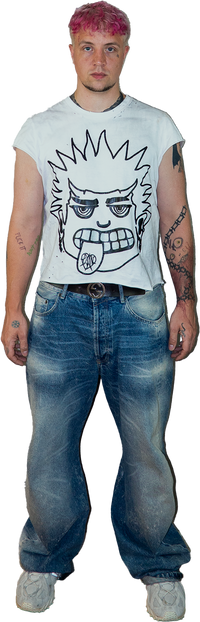
At 300 GSM, one fold fewer is often enough. A heavy shirt in thirds turns into a brick: it stands, but it eats half the drawer. A light shirt like our DIRT MOUTH at 180 GSM, on the other hand, folds down small without trouble. Don't smooth its open raw hems while you do, they are allowed to ripple slightly.
Folding a T-shirt in 2 seconds: the three-grip trick
The trick has been doing the rounds online as a video for years. In June 2013, ABC News counted almost three million views for the clip by the Englishman Dave Hax, a good week after it was uploaded. It looks like a magic trick and is pure geometry: all three grip points lie on one line.
- Lay the shirt front side up, across in front of you, collar on the left, hem on the right. Left-handers do everything mirrored.
- In the half that is closer to you, picture a straight line. It runs parallel to the long edge from the shoulder to the hem.
- Three points lie on this line: A on the shoulder, exactly between the collar and the end of the shoulder. B in the middle of the shirt. C at the hem.
- Grab A with your left hand and B with your right.
- Move your left hand over your right to C and grab C as well. Your arms are now crossed, and your left hand holds A and C together.
- Lift the shirt, pull your hands apart and uncross your arms as you do. The shirt hangs briefly between your hands and folds itself.
- Put it down with a small swing and let the hanging side fold under the bundle.
If the result comes out crooked, the points don't lie on one line. Do the first few runs in slow motion, the two seconds come by themselves. Heavy oversized shirts need more swing, and the dropped shoulders like to land crooked: tug them straight once. Our verdict: brilliant for the Sunday laundry pile, too imprecise for a shelf where the stacks are meant to look like something.
Folding a T-shirt with a folding board
Sheldon Cooper demonstrated it in “The Big Bang Theory”, in the first episode of season two: shirt on the board, three flaps, done. Good Housekeeping was still recalling the scene years later. A laundry folding board is a plastic plate made of several panels that fold against each other. Its real advantage is the shape: every bundle comes out exactly the same size, and a stack of identical rectangles doesn't tip.
- Lay the board flat and the shirt on it front face down. The collar sits centred against the top edge of the middle panel.
- If, on wide oversized cuts, fabric sticks out beyond the board at the sides, fold it in by hand first. Otherwise the flap pulls it crooked.
- Flip the left side panel in and straight back again. The side and sleeve stay folded.
- The same with the right panel.
- Flip the bottom panel up and back.
- Pull the bundle off the board and turn it over.
The board is worth it if you fold a full basket every week. For five shirts a month, your hands are enough.
How to make a folding board from cardboard
A moving box, a box cutter, parcel tape. That is all you need. There are two ways to build one: the quick template and the folding board that works like a bought one.
Option 1: one-piece template
- Cut a rectangle from sturdy cardboard. For shirts in S to L, around 23 by 34 centimetres fits, for oversized cuts more like 27 by 36. The height should be roughly half the shirt length, so that the hem reaches exactly up to the collar at the end.
- Lay the shirt front face down and the template centred on the back, top edge directly under the collar.
- Fold both sides together with the sleeves over the template and flip the sleeves back to the edge.
- Flip the hem up over the template.
- Pull the template out at the top by the collar and turn the bundle over.
Option 2: folding board with six panels
- Cut six panels of equal size, each around 23 by 34 centimetres (oversized: 27 by 36).
- Lay them out in two rows of three panels each, with half a centimetre of gap between the edges. That gap becomes your hinge.
- In each of the three columns, connect the top panel to the bottom one with parcel tape across the whole gap.
- In the top row, connect the middle to the left and to the right. In the bottom row, the middle stays loose, otherwise nothing will fold.
- Tape every seam from both sides. Then the tape won't tear after three laundry days.
- Fold as above: collar at the top edge of the top middle panel, then the left column, the right column, then the bottom middle panel up.
T-shirts for your suitcase: roll or fold?
Our rule: basics and sleep shirts get rolled, anything with a print and anything from 250 GSM travels flat. Rolled shirts fill every gap next to shoes and wash bag and arrive with soft waves instead of sharp edges. A thick oversized shirt, rolled, gets as thick as a forearm, though, and barely saves any space.
How the ranger roll works
The ranger roll, also called the military roll, turns a shirt into a firm sausage that doesn't unroll by itself. For the wardrobe it is too much effort, in a rucksack it is unbeatable.
- Lay the shirt flat, front face down.
- Turn the bottom edge all the way round outwards by about a hand's breadth, like the cuff of a sock. That creates a pocket.
- Fold both sides together with the sleeves to the middle until the strip is as wide as you want the roll to be long.
- Roll tightly from the collar side towards the hem. Tightly means: no air stays inside the roll.
- At the end, reach into the turned-out pocket and pull it over the whole roll. Now the shirt is locked.
Print shirts and heavyweights in a suitcase
Fold them the classic way, lay them flat in a packing cube and put them right at the top of the suitcase. A shirt that spends a week under jeans and sneakers arrives with deep creases. At your destination, hang the shirts on a hanger in the bathroom while you take a hot shower. The steam pulls light creases out.
Heavyweight shirts at 300 GSM: fold, don't hang
A 300 GSM shirt almost stands on its own, and it has weight. That is exactly what becomes a problem on a hanger. Jersey is a knitted fabric, and single jersey is very stretchy. If a heavy shirt hangs for weeks, its own weight pulls at the shoulders, and the ends of the hanger press two bumps into it that you spot in the mirror at once. What exactly the number 300 measures is explained in our article What Does GSM Mean for T-Shirts?
Fold heavy shirts wider and with fewer layers, then the stack stays flat and stable. If you do hang them: a wide, rounded hanger, and pull the shirt over the hanger from below instead of through the collar. That way the neckline doesn't stretch out.
Light shirts you can hang if there is room. Our heavyweight T-shirts such as LIKE KURT or SHOTTIE at 300 GSM belong folded in the compartment.
Folding T-shirts with prints: never through the motif
A crease straight through a screen print is the first thing you see on a folded shirt. That is why the fold lines run beside the motif, never through it.
- Chest print: The classic method works, the horizontal fold sits below the motif.
- Large front motif down to the stomach: Flip the hem up only as far as the bottom edge of the motif. If need be, fold in thirds so both creases sit above and below the print.
- Wide motif: Fold the sides in less far. The bundle gets wider, the print stays whole.
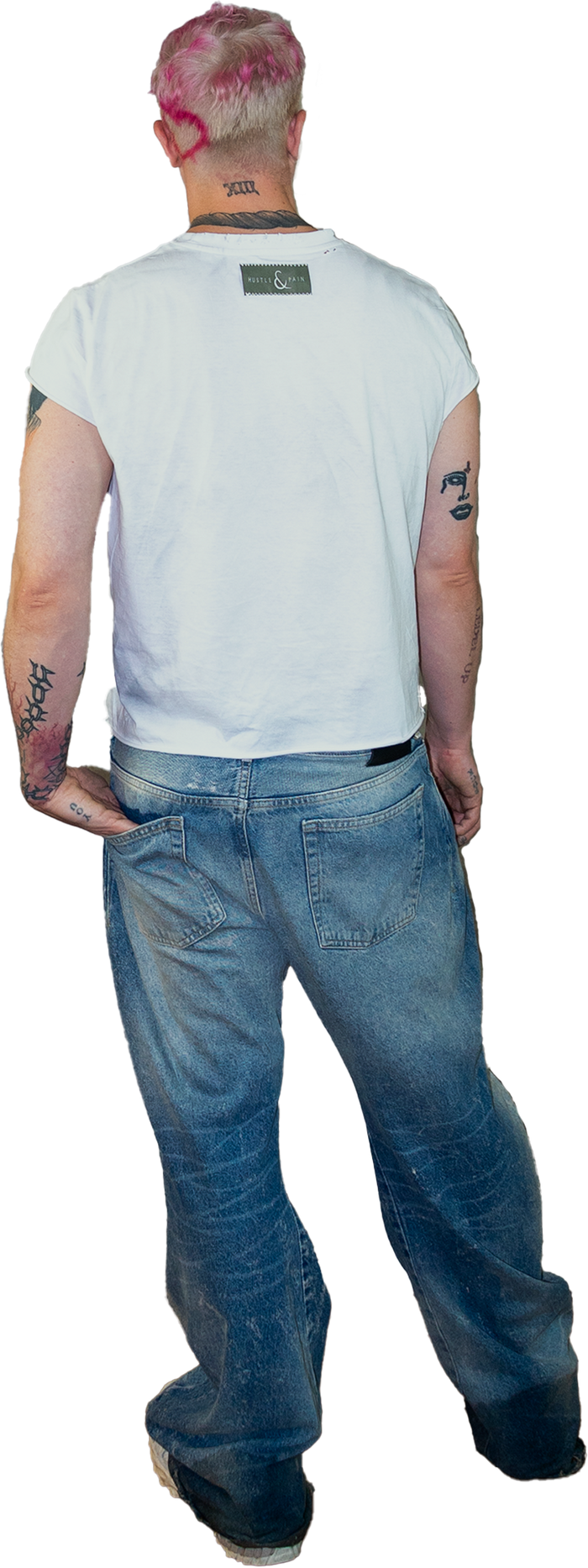
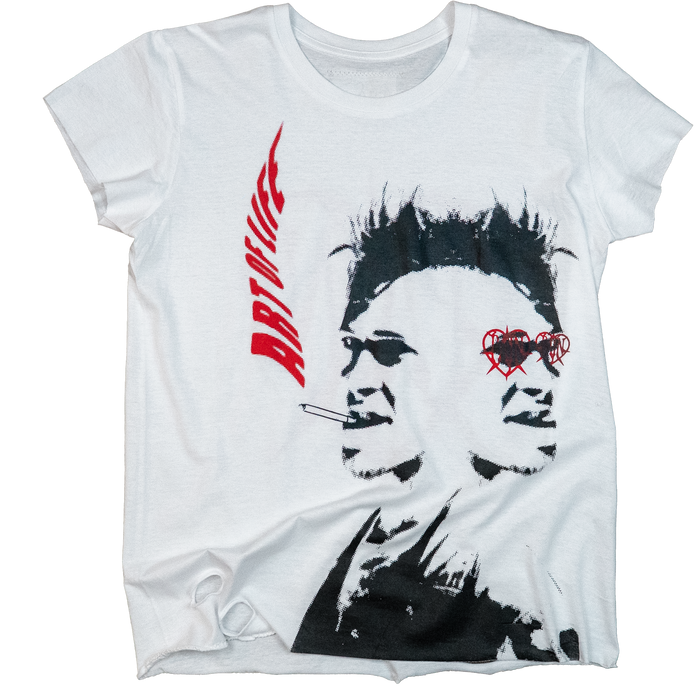
- Back print: Our ART OF LIFE carries the red PAIN heart on the back. The side flaps may lie over the heart, the fold edge must not run through it.
Don't put a print shirt at the very bottom of a tall stack, because a crease gets more stubborn under weight. You can iron it out in the fabric, but not over the print itself: according to the US screen-printing supplier Lawson, the printed area should never be ironed. You will find all the shirts with a large motif under Graphic Tees.
Sources6
- Wikipedia: Marie Kondō (in German)
- KonMari: How to Fold Clothes with the KonMari Method
- ABC News: Can You Fold a T-Shirt in Two Seconds Flat? (20 June 2013)
- Good Housekeeping on AOL: Big Bang Theory Fans Can Get Sheldon Cooper's Shirt Folding Board (20 May 2023)
- Wikipedia: Jersey (Stoff) (in German)
- Lawson Screen & Digital Products: General Information about Screen Printing Plastisol Inks
From the article


Keep reading
-
 Style11 minWhat Is Gothic Streetwear?
-
 Style13 minWhat Goes with a Black T-Shirt?
-
 Style13 minWhat Goes with a Grey T-Shirt?