What Is Minimal Streetwear?

Quick answer
Monday morning on the underground: black shirt, grey trousers, white sneakers, no logo, and people still look twice. That is minimal streetwear: wide shirts, hoodies and sneakers in calm colours such as black, grey and white, with little print. The look comes from the cut, heavy fabric and colours that go together.
Minimal streetwear at a glance
- What: streetwear with few logos, few colours and little print
- Colours: only a few per outfit, mostly black, grey, white, beige
- Cut: often one piece wide, the other straight
- Fabric: heavy and dense, from around 250 grams per square metre
- Print: little, often just one, and it tends to be narrow or small
- Shoes: plain and clean
- Test: photograph the outfit, switch the photo to black and white and see how cut and shape come across
- In focus: fabric and fit, because no logo and no colour distract from them
Quick questions
What does minimal streetwear mean?
Minimal means pared back. You wear perfectly normal streetwear but leave out big logos, lots of colours and loud prints.
Is minimal streetwear the same as a clean look?
Almost. A clean look is mainly about being neat: clean shoes, nothing creased, no lint. Minimal streetwear is a whole style, and clean is part of it.
What colours do you wear with minimal streetwear?
Black, grey and white are the base, and beige, olive and navy go with them. Three colours per outfit are typical, shoes included.
Can you wear a printed shirt with minimal streetwear?
Yes, of course. If it is the only patterned piece in the outfit, the look stays calm. A narrow or small motif is the quietest.
Which brands make minimal streetwear?
Well-known names are Fear of God Essentials for calm streetwear and COS or Muji for plain basics. Jil Sander stands for expensive minimalism. An expensive brand is not needed for the look, though.
How is it different from quiet luxury?
Quiet luxury means understated luxury: expensive clothing without a logo, such as cashmere jumpers and wool coats. Minimal streetwear takes the same idea and translates it into T-shirts, hoodies and sneakers.
In detail: colours, cuts, outfits and brands
Back to the outfit from the start. Why do people look twice when there is nothing written on it? Because the shoulder sits right, the fabric falls well and the three colours belong together. Here is how that works, step by step.
What is minimal streetwear? Streetwear, only quieter
Minimal streetwear uses the same pieces as any streetwear. T-shirt, hoodie, wide trousers, sneakers, cap. The difference: you turn the volume down.
The big logo on the chest goes, and so do the five colours. What remains is a clear shape, two or three colours and a fabric you can see and feel.
A quick test: photograph your outfit and switch the photo to black and white. That shows you how the cut and proportions come across. In this style they carry the look, because no colour and no logo distracts from them.
Minimal streetwear, clean look, quiet luxury: what is the difference?
The terms often get mixed up. Here is how to tell them apart:
- Basics: single pieces without a motif, such as a white shirt or grey joggers. Basics are ingredients, not yet a style.
- Clean look: describes how neat an outfit looks. Clean shoes, smooth fabrics, no lint. That works in any style.
- Normcore: a trend that became known in 2014. The idea: looking deliberately average, in jeans, a hoodie and ordinary trainers.
- Quiet luxury: understated luxury, meaning expensive clothing with no visible logo. Fine wool, cashmere, muted colours.
- Minimal streetwear: the calm of quiet luxury with the pieces of streetwear. Wide cuts and sneakers instead of cashmere and leather shoes.
Normcore wants to go unnoticed. Minimal streetwear wants to look intentional. In normcore everything can sit casually, in minimal streetwear every bit of width is planned.
Fernando Fastoso is a professor specialising in luxury brands at Pforzheim University. According to him, loud luxury appeals to the mass market. Quiet luxury is aimed at people who recognise a brand even without a logo. For streetwear, that is good news. There is no need to show anyone what your shirt cost. With this look, the fit does the talking.
Where does minimal streetwear come from?
The idea is older than most streetwear brands. Five moments are enough to understand it:
- Hamburg, 1967: Jil Sander, a German fashion designer, opens her first boutique. Later the press calls her the “Queen of Less”.
- Paris, 1981: Yohji Yamamoto, a designer from Japan, shows in Paris for the first time. His clothes are cut wide and mostly black. To him, black says: “I don't bother you, don't bother me.”
- Vienna and New York, 1990s: Helmut Lang, a designer from Austria, makes plain, practical clothes. In his spring 1998 collection he brings back the classic white T-shirt.
- USA, 2018: Jerry Lorenzo, founder of the streetwear brand Fear of God, launches Essentials, a more affordable line. According to Wikipedia, it is built on minimalism and comfort.
- 2023: The series “Succession” shows super-rich New Yorkers in expensive but inconspicuous clothes. Quiet luxury becomes a huge trend. By January 2024 it was already considered over.
So the label changes every few years. The idea behind it stays.
Which colours work for minimal streetwear?
Three colours per outfit are typical of the look, shoes included. White sneakers are then already one of the three.
- Base: black, grey, white. They go with everything and with each other.
- Plus: beige, olive, navy or brown. Usually one of these joins in.
- Tone on tone: one colour in several shades. For example dark grey trousers, a mid-grey shirt, light grey sneakers. It looks all of a piece.
- Accent: often just one, and small. A cap, a pair of socks or a print.
A tip for black: two shades of black look strongest when the difference is clearly visible. Deep black next to Washed Black, meaning black that has been washed out, looks intentional. With two almost identical blacks, the difference barely shows.
Minimal streetwear and the cut: wide, but with a plan
Minimal is not the same as tight. Most outfits in this style are loosely cut. What is typical is that the width looks intentional.
- One piece wide, one straight: a wide shirt with straight jeans, or a slimmer shirt with wide trousers. That way you can see the width is on purpose.
- Hem at the hip: the shirt ends roughly where the zip of the trousers stops. If it hangs down to the thigh, the legs look shorter and the upper body longer.
- Shoulder seam: on an oversized shirt, meaning a shirt cut wide on purpose, it sits a little below the shoulder. That is how it is meant to be.
- Trouser length: the trousers end on the shoe or just above it. A few soft folds over the shoe look calm, a big pile of fabric more relaxed.
- French tuck: tuck a hand's width of the shirt into the front of your trousers and leave the rest out. That shows the waist and gives wide on wide more shape.
More ideas for tucking, rolling and combining are in How to Wear an Oversized T-Shirt? The shirts themselves are under Oversized T-Shirts.
Why heavy fabric matters so much in minimal streetwear
This is the part many people overlook. With a loud graphic tee, everyone looks at the motif. With a calm shirt, everyone looks at the fabric.
Thin fabric clings to the stomach and shows every crease. The collar goes wavy after a few washes. Heavy fabric drops straight down and keeps its shape. The shoulder has an edge, the hem hangs smooth.
This is measured in GSM, grams per square metre of fabric. A normal T-shirt sits at around 180, heavy shirts at 250 to 300. How to check the number in the shop is explained in What Does GSM Mean on T-Shirts?
One more tip: matt cotton looks calmer than shiny synthetics such as polyester. Shine draws the eye. In a calm look, it stands out all the more.
The core pieces of minimal streetwear
You need less than you think. These eight pieces carry almost any outfit:
- Three heavy T-shirts in black, grey and white, because they turn up in almost every outfit.
- A hoodie without a big logo in grey or black, because it goes over any shirt.
- A pair of straight jeans in black or grey, because they keep wide shirts calm.
- A pair of wide trousers, tailored or in thick jersey, because they bring the width to a slimmer shirt.
- Plain white sneakers, because they lighten any dark outfit.
- An overshirt, a thick shirt you wear open like a jacket. It turns a shirt into a whole outfit.
- A dark winter jacket, because in winter it is almost the whole outfit.
- A cap or beanie without a big logo, because otherwise your head becomes the loudest part.
A complete list of 33 pieces for men and women is in What Is a Capsule Wardrobe?
Minimal streetwear outfits: six formulas to copy
All the formulas work for men and women. Our shirts are unisex, so they are cut for everyone.
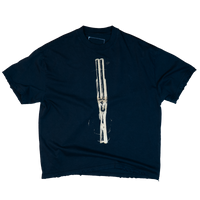
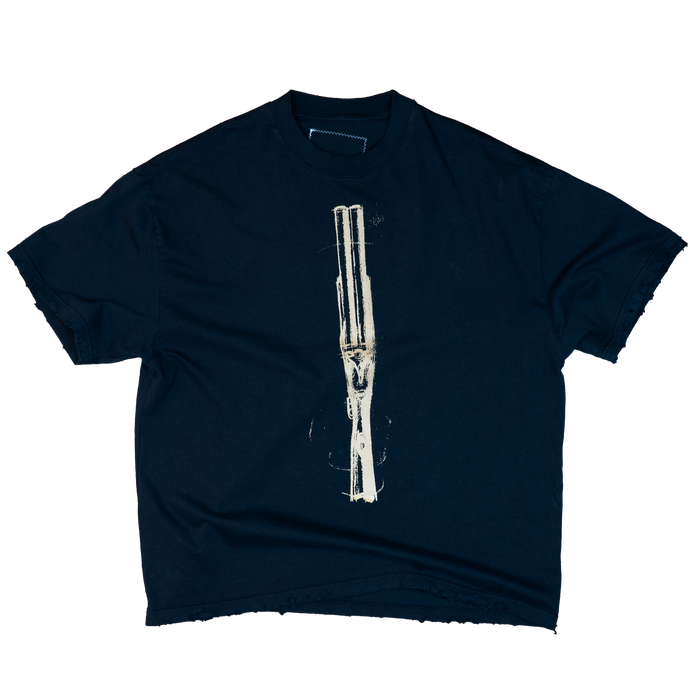
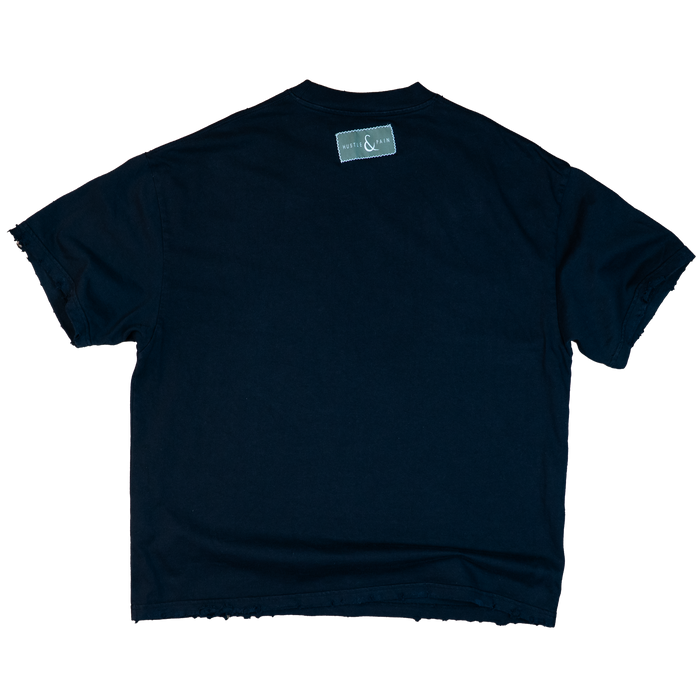
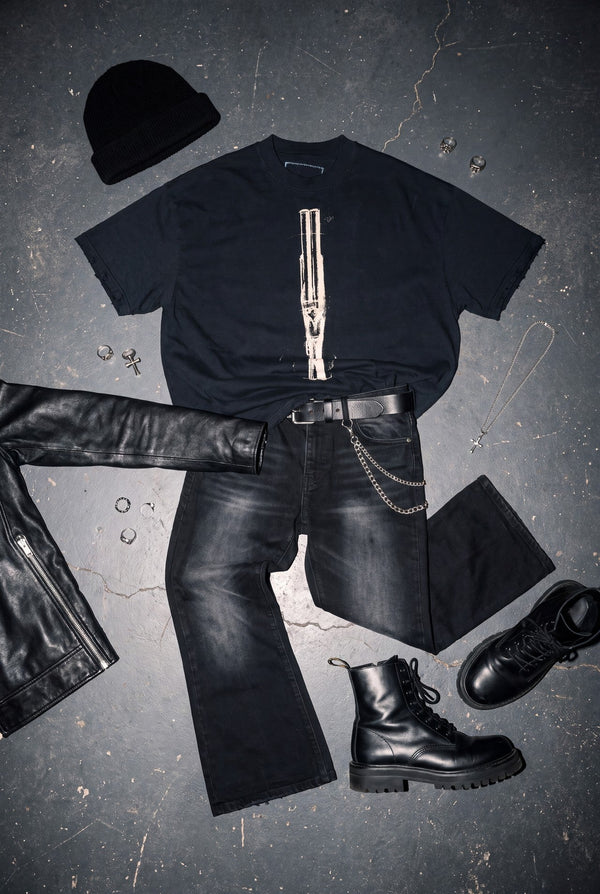
- Triple black: SHOTTIE in deep black, straight jeans in Washed Black, black sneakers with a white sole. The three blacks are clearly different, so it looks planned.
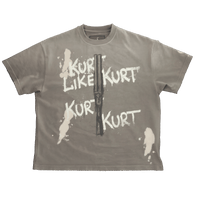
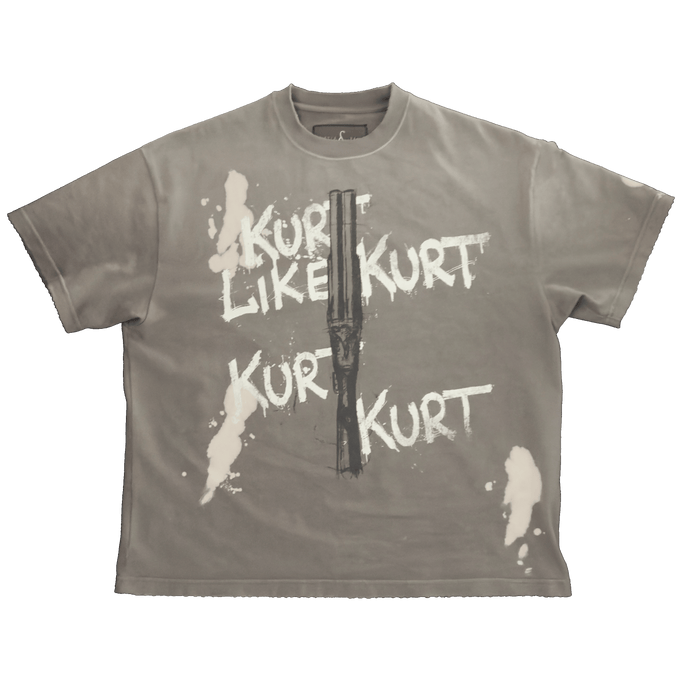
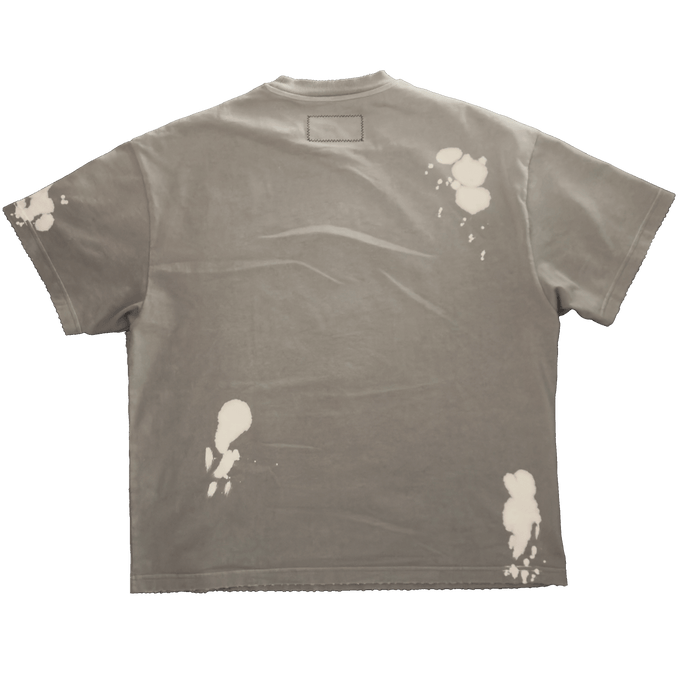
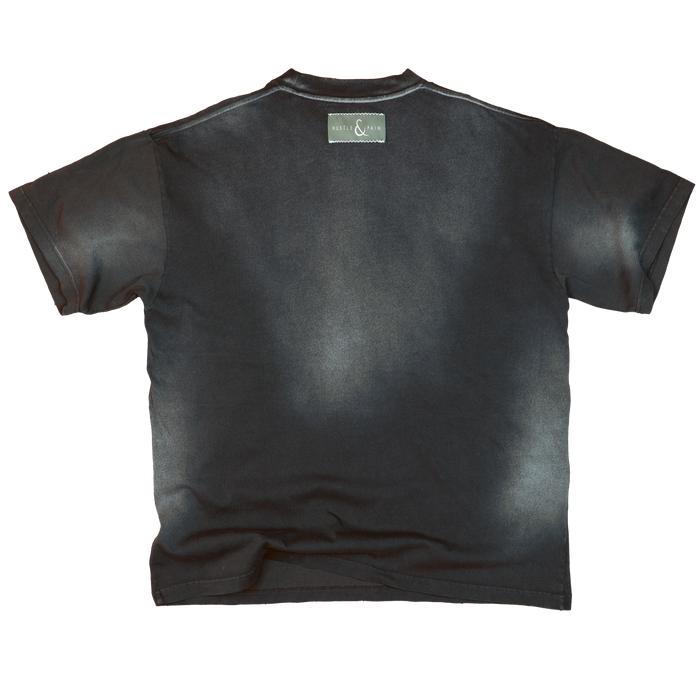
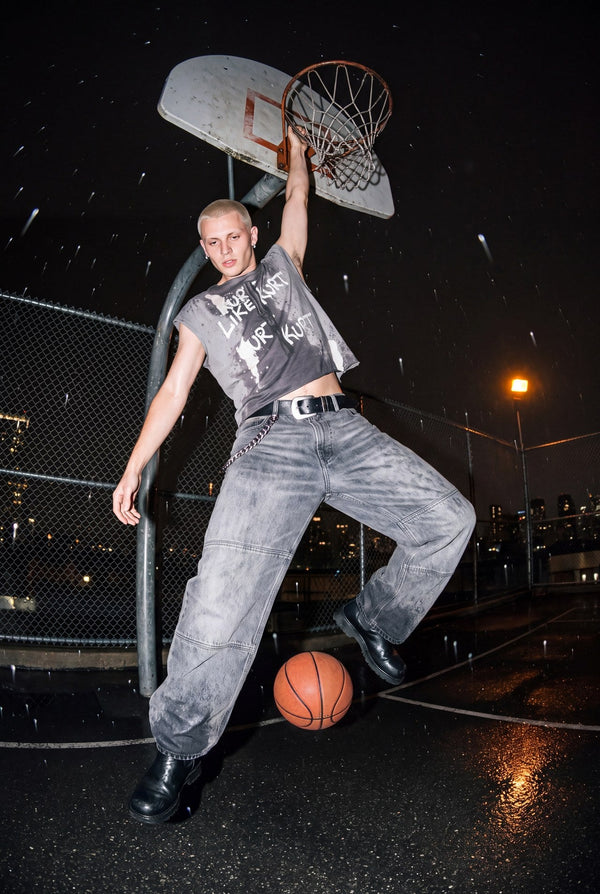
- Grey on grey: LIKE KURT in grey, light grey joggers in thick fabric, grey sneakers. The shirt is sun-faded, lightened as if after many summers in the sun. Then there are the bleached patches, which already bring pattern to the whole outfit.
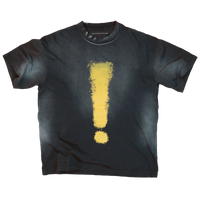
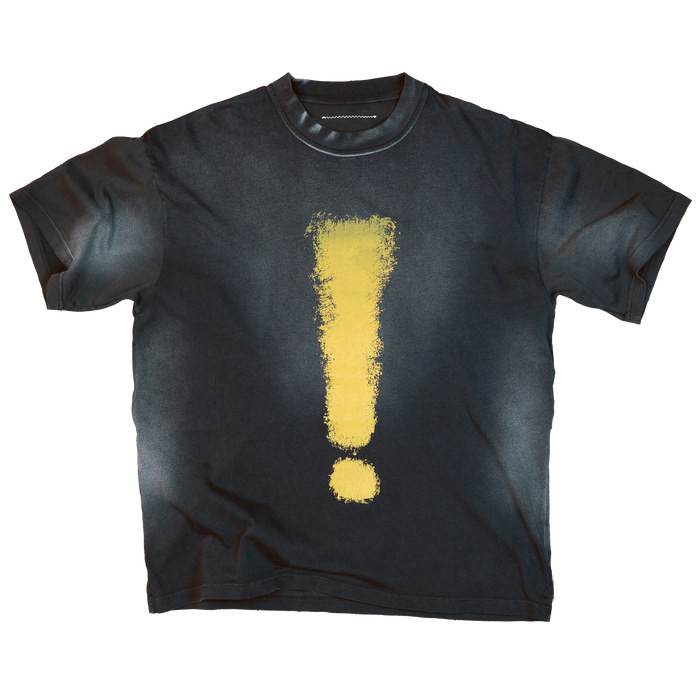
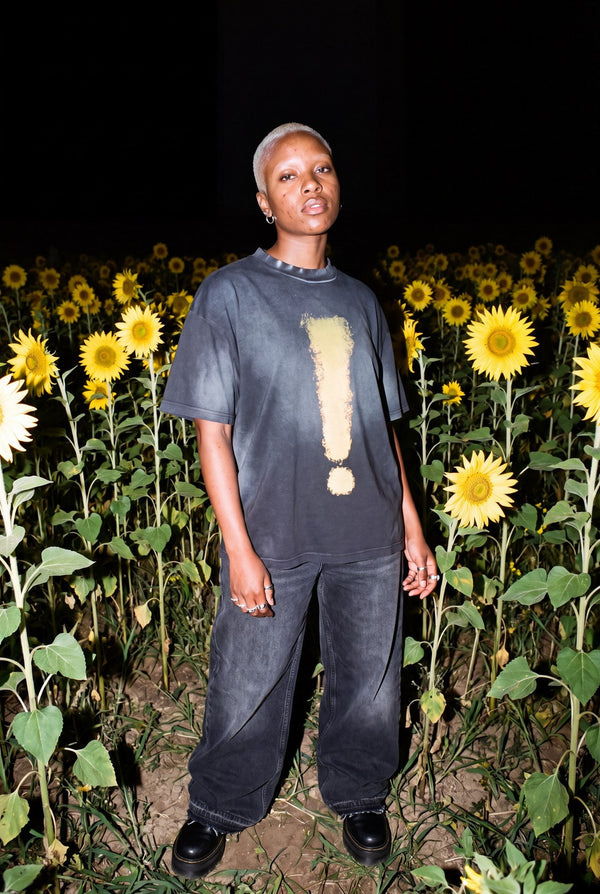
- One splash of colour: ENERGY in Washed Black with wide black trousers and black sneakers. On the front sits a big yellow exclamation mark. It is the only colour in the outfit, so it looks deliberate.
- Summer: black shirt, beige shorts to just above the knee, white sneakers, white socks. Longer shorts look calmer because they match the width of the shirt.
- High waist: grey oversized shirt in a French tuck, with wide, straight high-waisted jeans. Slim black belt, flat shoes. The belt shows the waist and gives the wide shirt shape.
- Winter: grey hoodie, a long black coat over it, black jeans, boots. Two fingers' width of white shirt peeks out from under the hoodie at the bottom. The light stripe breaks up all the dark.
You'll find all our heavy shirts at 250 and 300 GSM under Heavyweight T-Shirts.
How much print works in minimal streetwear?
To be honest: every shirt in our shop has a motif. We have no completely blank basic. The calmest are SHOTTIE in black and LIKE KURT in grey. ENERGY in Washed Black is calm in colour but loud in print. With these ideas, each of them still fits into a calm look:
- One print per outfit: if everything else stays free of pattern, the motif has the eye to itself.
- Narrow reads quieter: on SHOTTIE the motif runs narrow and vertical down the chest. That looks calmer than a big image.
- Show a colour once: if the print is yellow and nothing else is, the look stays calm. Yellow print, yellow cap and yellow socks together make it louder.
- Jacket worn open: under an open overshirt, only a strip of the motif shows. That makes the shirt quieter without you changing it.
- The wash counts as pattern: patches, bleach and frayed edges are decoration too. With a shirt like LIKE KURT, the look is therefore calmest when everything else is smooth.
Six things that change a calm look
In a calm outfit, every detail stands out more. These six things change the look:
- Thin fabric: a thin shirt without a motif falls softly, and because nothing distracts, you see that straight away.
- Simply sized up: a normal shirt two sizes bigger is not an oversized shirt. The collar gets wider and the hem hangs down to the thigh.
- Almost the same black: two blacks that differ only slightly look almost like one.
- Lint and stains: in a calm outfit, every stain shows. If you like it clean, grab a lint roller, which costs a few euros.
- Several logos: three small logos from three brands add up to a louder outfit.
- Everything wide: wide shirt, wide trousers, no tuck, slim shoes. Then the outfit flows without a fixed outline.
Minimal streetwear brands: who does what
A few names come up again and again. Here they are, briefly sorted:
- Muji, Japan: the full name translates as “no-brand quality goods”. Muji started in 1980 as the own label of a supermarket chain. Today it is good for simple, affordable basics.
- COS: a Swedish brand from the H&M Group, whose first shop opened in London in 2007. Plain clothes at mid-range prices.
- Fear of God Essentials, USA: the more affordable line from Fear of God, since 2018. Many people know the calm streetwear look from exactly this line.
- Jil Sander, Germany: minimalism as luxury. Beautiful, but expensive.
- HUSTLE&PAIN: heavy graphic tees, meaning T-shirts with a motif, from €75. Made for the idea of “one print per outfit”.
And the outfit from the start? Black, grey, white, no logo. Cut and fabric do the rest.
Sources9
- Wikipedia: Normcore (English)
- FashionUnited: Quiet Luxury, warum der Trend keine schnelle Modeerscheinung ist (28 February 2024, German)
- Wikipedia: Jil Sander (German)
- Wikipedia: Yohji Yamamoto (English)
- Wikipedia: Helmut Lang, fashion designer (English)
- Wikipedia: Jerry Lorenzo (English)
- Wikipedia: Quiet luxury (English)
- Wikipedia: Muji (English)
- Wikipedia: COS (English)
From the article
Keep reading
-
 Style11 minWhat Is Gothic Streetwear?
-
 Style13 minWhat Goes with a Black T-Shirt?
-
 Style13 minWhat Goes with a Grey T-Shirt?