What Is a Backprint?

Quick answer
Second row in the Columbiahalle, a concert hall in Berlin. After an hour and a half of the gig you know the back in front of you better than the singer: a washed-out black shirt, lettering at the top, two columns of city names beneath it. That is exactly what a backprint is: a design on the back of a garment, on a T-shirt usually large and between the shoulder blades. It has the most impact in a cut that keeps the back smooth, without a rucksack over it and anywhere people stand behind you.
Backprint at a glance
- What: a design on the back, usually large and between the shoulder blades
- Origin: kimono crests, back numbers in baseball from 1929, tour shirts with a list of cities
- Full back: around 30 by 35 to 40 centimetres, top edge 7 to 10 centimetres below the collar
- Four formulas: small on the front and big on the back, big on both sides, blank front, nape only
- Cut: oversized in your normal size, so the design doesn’t slip
- Wearing: a rucksack covers the print, tucked in all round the bottom of it disappears
- Jacket: works like a curtain, take it off and the back gets its entrance
- Print or embroidery: screen print lasts, large embroidery needs heavy fabric or outlines only
- Care: inside out, 30 °C, no tumble dryer, never iron over the print
Quick questions
What does backprint mean?
A backprint is a print on the back, so a design on the back of a garment. On a T-shirt it usually means a large graphic between the shoulder blades.
How big is a backprint on a T-shirt?
Print shops reckon on about 30 centimetres wide and 35 to 40 centimetres tall for a full back, so just under A3 paper size. The top edge usually sits 7 to 10 centimetres below the collar.
What size should I take for an oversized T-shirt with a backprint?
Your normal size. Oversized cuts are already made wide, and a size up lets the print slide downwards and fold.
Can you iron a T-shirt with a backprint?
Yes, but only from the inside or with a cloth in between, because the ink goes soft under a hot iron and can stick.
Are there T-shirts with a back print for women?
Yes, ART OF LIFE and YOKO ONO are unisex. If you like it snug, take the slim fit. If you want the back as a large, calm surface, take the long oversized one.
Where can I find streetwear T-shirts with a back print?
At HUSTLE&PAIN, ART OF LIFE carries the red PAIN heart large as a back print, with a portrait and red lettering on the front, both screen printed. YOKO ONO has a large embroidery on the back instead of a print.
In detail: origin, placement and styling
People stand behind you almost everywhere. In the queue outside the club, on the escalator down to the underground, in front of any stage, the first thing you see of most people is their back. And they see yours.
What is a backprint?
Backprint, back print, rear print: they all mean the same thing. German shops use the English word too, next to Rückenprint and Rückendruck. Any design on the back counts, from a small logo at the nape to a graphic running from shoulder to shoulder. Anyone who types “backprint T-shirt” into a shop, though, is almost always after the large version.
Strictly speaking, a backprint is printed: screen printed, digitally via DTG, or as a heat-pressed DTF transfer. A large embroidery on the back serves the same purpose with thread instead of ink. And the front always belongs to it: only the ratio of chest to back decides whether a shirt whispers or shouts.
Where does the backprint come from? Kimono, jersey, tour shirt
The back was a place for identification long before anyone printed on a T-shirt. The most formal Japanese kimono carries five family crests: two on the chest, one each on the back of the sleeves and one in the middle of the back. In baseball the back number arrived in 1929, when the Cleveland Indians became the first Major League team to take the field with numbers on their backs. The New York Yankees had the same plan, but their season opener was literally washed out. Ever since, people in the stands have known who is out there on the field without seeing a face.
Tour shirts: the band on the front, the cities on the back
On the T-shirt, it was above all band merch that claimed the back. Anyone who has ever queued at a merch stand knows the pattern: band and picture on the front, the tour on the back, city by city. The Victoria and Albert Museum in London has a shirt like that in its collection, printed in 1995 for David Bowie’s Outside tour. On the front, Bowie as Detective Nathan Adler in a grey hat with a cigarette. On the back, a blurred green face, OUTSIDE, and in red the stops from Hartford to Los Angeles.
Even better is a shirt from the same collection, made for the Japan concerts that Tin Machine, Bowie’s rock band, played in 1992. On the front, the band stands with its back to the camera. On the back, it turns around and looks at you, along with Kyoto, Osaka, Hiroshima, Tokyo and the other stops, each with a silver star. Somebody had a sense of humour.
Punk, surf and Stüssy: the back becomes streetwear
Punks painted band names on their leather jackets and covered them in studs and slogans. In autumn 1989, Shawn Stüssy, a surfboard shaper from Laguna Beach, then released his World Tour shirt, a name that already quotes the tour shirt. On the front, in sober Helvetica, are London, Paris, Los Angeles, New York and Tokyo, the fashion capitals. On the back, handwritten like graffiti, are Brooklyn, the Bronx, Compton, Santa Ana and Venice, the corners where street culture really lived. The stage on the front, the street on the back. In 2020, for the brand’s 40th birthday, designers such as Rick Owens and Virgil Abloh made versions of their own.
Why a T-shirt with a backprint works: people see you from behind
Count how often someone looks at you from the front without looking at your face. Rarely. From the front, every print competes with your face, with folded arms, with the strap of your bag and the open jacket. From behind, nobody talks over it.
And people stand behind you for longer than you think. In the club queue, the person behind has nothing to do for twenty minutes except read your back. At a gig, everyone looks forward, which means at the backs of the row in front. And anyone photographed while looking at the stage is a back in the picture.
Then there is the surface itself. Between the shoulder blades the fabric lies almost flat, with no chest or stomach to curve it. A large design stays legible there even when you move.
Small on the front, big on the back: four formulas for chest and back
Short at the front, long at the back: in the eighties that was a hairstyle, the mullet, known in German as Vokuhila (short for vorne kurz, hinten lang). The same principle works on a shirt. At heart there are four ways to divide front and back:
- Small on the front, big on the back: a logo or one line of text on the left of the chest, the whole design on the back. From the front it is a calm shirt that suits the office and dinner with your parents. The small mark at the front only gives away that there is more to come at the back.
- Big on both sides: the tour shirt formula. Loud from both sides. With dark trousers and plain shoes the shirt takes centre stage, and a second pattern makes the whole look louder.
- Blank front, everything on the back: From the front you see a washed shirt without a design, and the punchline comes when you turn around.
- Nape only: a small logo or a line just under the collar. Quiet and quickly covered, by long hair as much as by a hood.
Our view: to start with, the first formula is the safest, because it works everywhere. The third has the most impact, because nobody expects it.
Where does a backprint sit? Placement and size
On the back, print shops work with a handful of standard positions, and the guideline figures are similar across providers, for instance in the placement guide from ScreenPrinting.com and the size guide from the print shop 4OVER4:
- Nape: a small design, a few centimetres wide, just under the collar seam. Many outer labels sit here too.
- Upper back: a wide, flat strip across the shoulder blades, about 30 centimetres wide and around 10 tall. The classic spot for lettering, like the name above the number on a jersey.
- Full back: about 30 centimetres wide and 35 to 40 tall, so just under A3 paper size. The top edge sits 7 to 10 centimetres below the collar, a short hand’s width.
- Lower back: rare, and rightly so, because jackets, bags and tucked-in shirts cover exactly this spot first.
A detail hardly anyone knows: the ScreenPrinting.com guide recommends printing mostly the same design size on adult shirts from S to XL. On a shirt in S, the same print therefore fills a good deal more of the back than on an XL.
The size of the shirt counts double with a backprint. If it is too tight, the design is pulled apart across the shoulder blades. If it is too wide, it slides down with the shoulder seam and creases. For oversized, that means your normal size. The cut is already made wide, and a size up only pushes the print further down.
Wearing a T-shirt with a backprint: how to keep the back clear
Wearing the jacket open so the backprint stays visible doesn’t help much. A jacket covers the back, open just as much as closed.
One idea: use the jacket as a curtain. On the way there, the open overshirt shows the chest. In the club or in front of the stage it comes off, and the back gets its entrance. Slung over the shoulder or tied around the hips, it at least leaves the upper back free. Two more things:
- A rucksack covers exactly the surface that matters. A cross-body bag leaves it free.
- Tuck the shirt in all the way round and the bottom of a large backprint disappears and pulls into folds. Tucked in only at the front, the back stays clear.
Oversized T-shirt with a backprint
Oversized and backprint go together, because the wide cut forms a broad, smooth surface at the back on which even a large design doesn’t strain. At 300 GSM the back hangs heavy and straight, and the design doesn’t ripple with every step. Wide trousers carry the wide shape on downwards, while tight jeans set up a contrast: wide on top, narrow below. Our wide shirts are under Oversized T-Shirts.
Backprint T-shirt for men: three outfits
- Calm at the front: YOKO ONO, wide light jeans, white sneakers. The back does the work.
- Gig night: ART OF LIFE, black cargo trousers, a track jacket for the journey that moves over the shoulder in front of the stage.
- After work: a shirt following the formula small on the front, big on the back, with dark chinos and loafers. Office from the front, weekend from the back.
T-shirt with a back print for women
Our shirts are unisex, and the ideas above apply just the same. Long, loose hair completely covers a nape print and the top edge of a large backprint along with it. Ponytail or bun if the back is meant to count. The front tuck, where only the front edge goes into the waistband, shows the waist and leaves the back alone. And a slim fit like ART OF LIFE sits close to the body, so the red heart lies exactly between the shoulder blades. With wide, low-rise jeans, that is the silhouette of the early 2000s.
Print or embroidery? What lasts on the back
A printed backprint is ink on or in the fibre. In screen printing it sits as a layer of its own on the fabric, rich and opaque, and when properly cured it lasts as long as the shirt. How the process works and how to tell it apart from DTG and DTF is covered in What Is Screen Printing?.
Embroidery is thread stitched through the fabric. It can’t crack or crumble like an old layer of print, it has relief and it catches the light. The price is weight on the fabric, and a large, solidly filled embroidery can pull a thin shirt together. On the back it therefore needs heavy fabric or a light hand, meaning outlines instead of filled areas.
How screen printing, wash and dyeing work together on our shirts is shown in T-Shirt Finishing Explained.
Caring for a backprint: inside out, 30 °C, no tumble dryer
- Wash the shirt inside out, because otherwise the print rubs against the drum and against other people’s zips. With embroidery, the threads then don’t catch on hooks and Velcro.
- Wash at 30 °C, because every step above that does more damage to the colour and the cotton.
- Don’t use a tumble dryer, because the heat attacks the layer of ink and makes cotton shrink.
- Never iron over the print, because screen printing ink goes soft under a hot iron and can stick. Iron from the inside or put a cloth in between. You iron an embroidery from the inside on a towel, so the stitches keep their relief.
- Dry flat or on a wide hanger, because wet cotton on a thin wire hanger goes out of shape at the shoulders.
A backprint picks up most of its wear outside the washing machine, though: from the rucksack, from the back of the office chair, from the car seat. Anything that rubs across your back every day grinds away at the design over months.
Our backprint T-shirts: ART OF LIFE and YOKO ONO
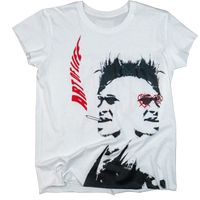
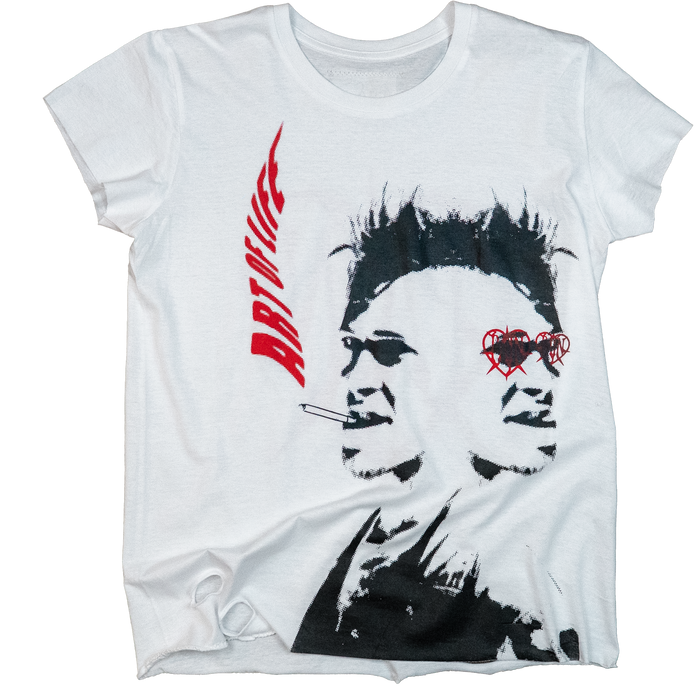
ART OF LIFE follows the tour shirt formula, big on both sides. On the front, a portrait in coarse halftone dots and, alongside it, running lengthways, the red ART OF LIFE lettering. On the back, the red PAIN heart sits centred between the shoulder blades: a heart with points like a star, with PAIN inside in sharp letters, and above it the green embroidered label on the outside at the nape. The designs are screen printed. The shirt itself is a slim fit in Vintage White, in 150 GSM organic cotton, ring-spun and combed, with distressed hems. That is how narrow and light shirts fitted in the underground of the early 2000s.
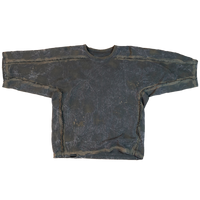
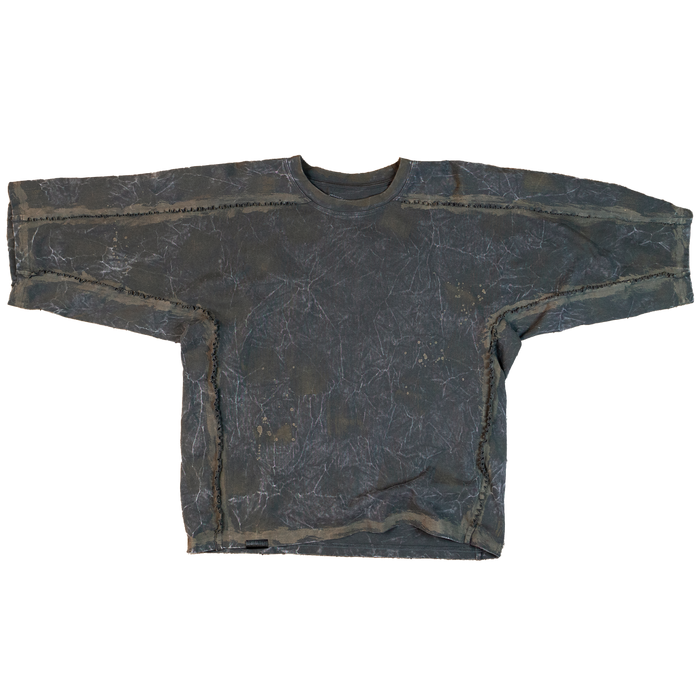
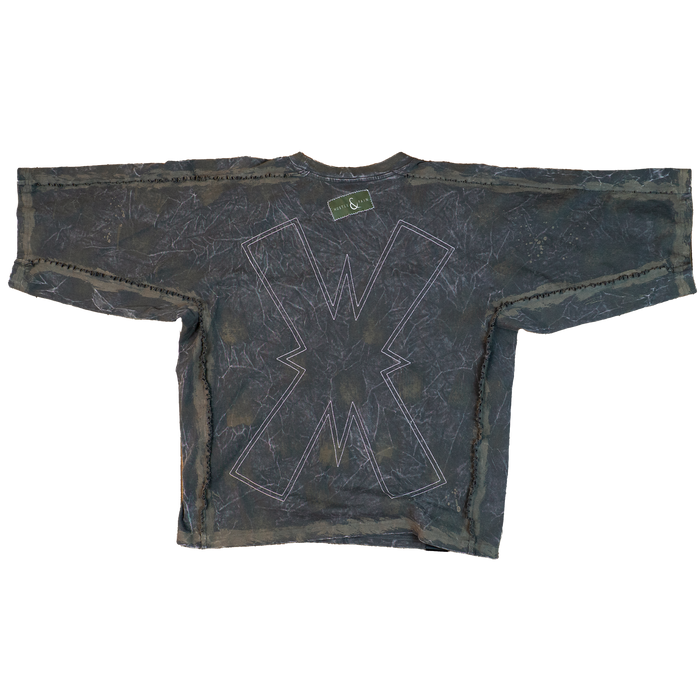
YOKO ONO turns that around: blank front, everything on the back. From the front you see only Vintage Grey with a marble wash and exposed seams, distressed by hand. On the back, a large contrast embroidery runs from the nape almost to the hem, as an outline only, in light thread, with a double stitch line. Because no area is filled in, the back stays soft and drapes like the rest of the shirt. The cut is inspired by the kimono: sleeves and body are one piece, and there is no shoulder seam. Extra long, oversized, 300 GSM. On the formal kimono, a crest sits right in the middle of the back. On YOKO ONO, the embroidery sits there.
You’ll find more screen-printed designs in our Graphic Tees, all unisex and made of 100% cotton, dropped in small numbers.
And next time you’re standing in the second row: someone behind you has an hour and a half to read your back. Give them something.
Sources12
- Wikipedia: Mon, Japanese family crests (English)
- Wikipedia: Uniform number, Major League Baseball (English)
- Victoria and Albert Museum: T-shirt for David Bowie's Outside tour, 1995 (English)
- Victoria and Albert Museum: T-shirt for the Tin Machine Japan concerts, 1992 (English)
- Wikipedia: Tin Machine (English)
- Wikipedia: Punk fashion (English)
- Wikipedia: Stüssy (English)
- Stüssy: Stüssy World Tour (15 February 2022, English)
- Stüssy: Stüssy World Tour Collection (16 November 2020, English)
- Wikipedia: Vokuhila (German)
- ScreenPrinting.com: T-Shirt Design Placement Guide (12 June 2026, English)
- 4OVER4: T-Shirt Design Size Width and Height Guide (17 January 2026, English)
From the article

Keep reading
-
 Style11 minWhat Is Gothic Streetwear?
-
 Style13 minWhat Goes with a Black T-Shirt?
-
 Style13 minWhat Goes with a Grey T-Shirt?